



Expertly Written By
Dr. Rocco Piazza, MD, FACS
Board-Certified Plastic Surgeon practicing in Austin, Texas, and the physician who selects every product on our skincare shelf.
At a Glance
Short answer: Yes, several chemical (organic) filters reach the bloodstream in measurable amounts
What the FDA found: Levels above 0.5 ng/mL, the point at which the agency asks for more safety data
What it does not mean: That those filters are harmful. The FDA and the study authors both said keep using sunscreen
The number that matters: Daily use. Any broad-spectrum SPF 30+ you will actually wear
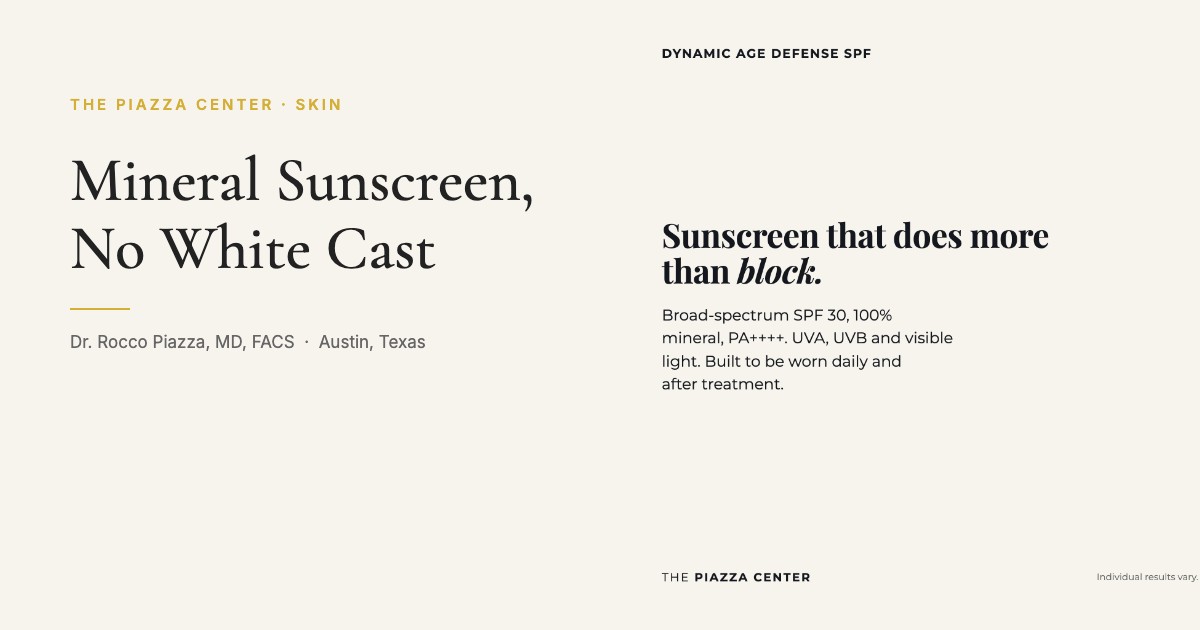
What I wear: Mineral, as a personal preference — Pavise Dynamic Age Defense SPF 30
Why This Matters: Every summer the "sunscreen in your blood" headline does the rounds, and every summer I meet patients who stopped wearing sunscreen because of it. Skipping sunscreen carries a known risk; the absorption findings carry an open question. Those are not the same size of problem. Individual results vary.
Every summer, patients ask me whether they should throw out their sunscreen. They have seen a video saying the FDA "found sunscreen chemicals in people's blood" and that they stay there for weeks. Both of those things are true. The conclusion people draw from them is not.
So here is what the FDA actually measured, what the famous 0.5 ng/mL number means, what has changed at the agency since, and why my advice is the same as it has always been: wear sunscreen, and wear the one you like enough to put on every day.
Key Takeaways
- Two FDA trials (JAMA 2019 and 2020) found common chemical filters in blood above 0.5 ng/mL, sometimes after a single application.
- 0.5 ng/mL is a screening line that triggers more testing. It is not a toxicity limit, and the authors wrote that people should not stop using sunscreen.
- Mineral sunscreen is a reasonable preference, not a safety requirement. The best sunscreen is the one you will wear daily.

Is Sunscreen Absorbed Into Your Bloodstream?
Yes. In two FDA clinical trials, common chemical sunscreen filters such as avobenzone, oxybenzone and octocrylene showed up in blood above the FDA's 0.5 ng/mL screening threshold, in some cases after one application. That threshold means the agency wants more safety data. It does not mean the ingredients are harmful, and both the FDA and the researchers told people to keep using sunscreen.
The FDA put it plainly: "The fact that an ingredient is absorbed through the skin and into the body does not mean the ingredient is unsafe." (FDA)
What the Two FDA Studies Measured
The 2019 study. FDA researchers led by Murali Matta gave 24 healthy adults one of four products: two sprays, a lotion and a cream. Participants applied 2 mg/cm² to 75% of their body, four times a day for four days. That is a deliberately extreme "maximal use" design — roughly what you would use if you were in a swimsuit, reapplying properly, all day, for four days running. All four filters tested (avobenzone, oxybenzone, octocrylene and ecamsule) passed 0.5 ng/mL on day one. Oxybenzone ran highest, around 170–210 ng/mL at peak depending on product. (JAMA, 2019)
The 2020 study. The follow-up doubled the group to 48 adults, tested a lotion and three spray types, and added homosalate, octisalate and octinoxate. This time participants applied once on day one, then four times daily on days two to four. All six filters crossed 0.5 ng/mL after that single first application. Peak oxybenzone in the lotion group was 258.1 ng/mL. (JAMA, 2020)
Both papers closed on the same sentence, near word for word: these results do not indicate that individuals should refrain from using sunscreen.
0.5
ng/mL
The FDA's screening line. Above it, the agency wants more toxicology data.
75%
of the body
Covered at 2 mg/cm² in both trials — a beach-day dose, not a face-only dose.
6 of 6
filters
Crossed the line after one application in the 2020 trial (48 adults).
0
harms shown
Neither trial was designed to show harm, and neither concluded any. Rash was the main side effect.
Sources: Matta et al., JAMA 2019;321(21):2082–2091 and JAMA 2020;323(3):256–267; FDA, "Shedding New Light on Sunscreen Absorption."
What 0.5 ng/mL Actually Means
This is the number that gets misread most. Under the FDA's framework, 0.5 ng/mL is the level below which a sunscreen ingredient can skip certain extra toxicology studies, including cancer studies. It is tied to a deliberately conservative cancer-risk estimate. (FDA)
In other words, it is a "do more homework" line, not a "danger" line. Crossing it means the FDA wants data it does not yet have. The chemical filters sold in the US were approved decades ago on the assumption that they stayed below that level, so the studies were never required, and that data largely does not exist yet.
A level being "500 times the threshold" sounds alarming in a video. It is 500 times a screening trigger, not 500 times a toxic dose.
What Dr. Michelle Wong (Lab Muffin Beauty Science) Gets Right
The clearest public explanation of all this comes from Dr. Michelle Wong, the PhD chemist behind Lab Muffin Beauty Science. She has covered every step of this story, and her reading is correct and well supported. I agree with her.
- The threshold. She explains that 0.5 ng/mL is a Threshold of Toxicological Concern — a very low, cautious limit — and that the new studies are being asked for because "the data doesn't exist yet", not because harm was found. (Lab Muffin)
- The scale. In her breakdown of the 2019 study she estimates that the fraction of applied sunscreen reaching the blood was on the order of 0.001%. She also points out that absorption studies in humans go back to the late 1990s; this was not new news. (Lab Muffin, 2019) (Lab Muffin, 2020)
- Hormones. On the claim that oxybenzone disrupts hormones, she walks through why binding to a receptor in a dish is not the same as an effect in a person, and why dose decides everything. (Lab Muffin) The EU's 2021 reassessment did not find enough evidence of endocrine disruption; it lowered oxybenzone to 2.2% in body products to keep a 100-fold safety margin, while leaving 6% for face products. (Lab Muffin)
- Reefs. Lab studies used concentrations far above what is measured in most ocean water, and the 2022 National Academies review found that chemical and mineral filters overlap in their effects on aquatic life — zinc oxide is not automatically "reef safe." (Lab Muffin) (National Academies)
Her summary of the "low-tox" sunscreen swaps going around social media is the one I would give a patient: chemical filters are not harmful at the levels used in sunscreen, and the bigger risk is people abandoning sunscreen altogether. (Lab Muffin)
Video: Dr. Michelle Wong, Lab Muffin Beauty Science, on what the EU's oxybenzone decision does and does not mean.
Sources: FDA; FDA proposed order Q&A (2021); EU SCCS via Lab Muffin Beauty Science; National Academies of Sciences, Engineering, and Medicine (2022).
Where the FDA Stands Now
In February 2019 the FDA proposed new rules for the 16 sunscreen active ingredients on the US market. It proposed that only zinc oxide and titanium dioxide be classed as generally recognized as safe and effective (GRASE); that PABA and trolamine salicylate are not; and that the other 12 — including avobenzone, oxybenzone, octocrylene, homosalate, octisalate and octinoxate — need more data before a decision. (FDA release)
The agency reissued that proposal as a proposed order in September 2021 and stated it "does not represent a conclusion by the FDA" that the 12 ingredients are unsafe. The order is not final, and those sunscreens remain legally on sale. (FDA)
The newer development points in a useful direction. In June 2026 the FDA finalized bemotrizinol — a filter used for years outside the US, sold by BASF as Tinosorb S (Cosmetics Business) — at up to 6%, the first new sunscreen active added in more than two decades. It took effect in August 2026. (Holland & Knight) (Venable) The US is getting more options, not fewer.
The sunscreen timeline
Feb 2019 — FDA proposes zinc oxide and titanium dioxide as GRASE; 12 filters need more data.
May 2019 — First JAMA absorption study: 24 adults, maximal use.
Jan 2020 — Second JAMA study: 48 adults, levels above 0.5 ng/mL after one application.
Sept 2021 — Proposal reissued as a proposed order under the CARES Act. Not yet final.
Dec 2025 — FDA proposes adding bemotrizinol.
Jun–Aug 2026 — Bemotrizinol final order issued, then takes effect.
Sources: FDA; JAMA; Holland & Knight (Dec 2025); Venable LLP (Jun 2026).
Should You Stop Wearing Sunscreen?
No. Regular sunscreen use lowers the risk of sunburn and skin cancer and slows visible skin aging. Those are established outcomes. The absorption question is a request for data. The American Academy of Dermatology's advice is unchanged: a broad-spectrum SPF 30 or higher, water resistant, reapplied every two hours, plus shade and clothing. Any type — mineral, chemical or hybrid — meets that bar. (AAD)
As a surgeon, I see the other side of this too. Scars, laser results and pigment all hold up better on patients who wear sunscreen consistently. If a chemical sunscreen is what you will reach for every morning, wear it.
Reel: Dr. Rocco Piazza (@roccopiazzamd) on why daily sunscreen is still the step that matters most.
"The best sunscreen is the one you will put on tomorrow morning, and the morning after that. I happen to wear mineral, because I like how zinc wears on my skin and I like that its regulatory status is settled. That is my preference. It is not a warning about anything else on the shelf." — Dr. Rocco Piazza, MD, FACS
If You Prefer Mineral: The One I Use
Most people who try mineral sunscreen give up because of the white cast. That was my experience too, until Pavise Dynamic Age Defense SPF 30.

- Filter: 15% zinc oxide, 100% mineral, broad spectrum SPF 30, PA++++.
- Finish: untinted, with no iron oxides. Pavise reports it goes on transparent across skin tones, using its DiamondCore technology (a nanodiamond core paired with zinc oxide). More on that in our DiamondCore explainer.
- Extras: niacinamide, tranexamic acid, Pycnogenol and silymarin. Pavise also claims visible-light protection.
- What it cannot do: it is SPF 30, not 50. It still needs a generous layer and reapplication every two hours outdoors. And at $148 it costs far more than a perfectly good drugstore sunscreen.
Mineral sunscreens can be stubborn to wash off, so I pair it with Pavise Gentle Amino Powerwash ($64). Pavise states it removes mineral sunscreen in one wash, using amino-acid cleansers rather than harsh surfactants.

Our medical aesthetician Kari wore it through a full Austin summer — you can read how that went. If you are weighing it against a tinted option, see Pavise vs. EltaMD UV Clear Tinted, and for application technique, how to apply sunscreen to your face.

Sunscreen Absorption: Common Questions
Is sunscreen absorbed into your bloodstream?
Some chemical filters are, in small amounts. FDA trials in 2019 and 2020 measured them above 0.5 ng/mL, a level that calls for more safety testing. That is not evidence of harm, and the FDA advises continued sunscreen use.
Is chemical sunscreen bad for you?
No evidence shows harm at the levels used in sunscreen. The FDA has asked for more data on 12 filters and said that request is not a conclusion that they are unsafe. Dr. Michelle Wong of Lab Muffin Beauty Science covers this in detail, and I agree with her.
Is mineral sunscreen safer than chemical?
Zinc oxide and titanium dioxide have a settled regulatory status in the US, which some people find reassuring. That is a reasonable preference. It does not make chemical sunscreen unsafe, and mineral formulas have their own trade-offs, including white cast and texture.
Should I stop wearing sunscreen because of the FDA study?
No. Both studies stated that their results do not mean people should stop using sunscreen. Sun damage and skin cancer risk are well established; the absorption question is still being studied.
What is a non-toxic sunscreen?
"Non-toxic" is a marketing term, not a regulatory one. Toxicity depends on dose and exposure. Pick a broad-spectrum SPF 30 or higher you will wear every day; if you prefer mineral, choose zinc oxide or titanium dioxide.
Is oxybenzone banned?
Not by the FDA. The EU lowered its limit for body products to 2.2% and kept 6% for face products. Products containing it remain legally on sale in the US.
Does Pavise leave a white cast?
Pavise reports it applies transparent on all skin tones, and that has matched our team's experience. Application amount and skin type both affect finish. Individual results vary.
Individual results vary. The products discussed are cosmetic and over-the-counter products and are not intended to diagnose, treat, cure or prevent any disease. Manufacturer claims are attributed to the manufacturer. Cited studies are linked to their published sources. This article is for educational purposes and does not constitute medical advice; speak with a qualified physician about what is appropriate for your skin, particularly during pregnancy or for children.
Not Sure Which Sunscreen Fits Your Skin?
Dr. Rocco Piazza and our Austin aesthetics team can help you choose sun protection you will actually wear — mineral, chemical or tinted — around your skin, your pigment and your treatments.

Dr. Rocco Piazza II
Board-Certified Plastic Surgeon
Dr. Piazza is a board-certified plastic surgeon practicing in Austin, TX. He specializes in aesthetic and reconstructive surgery with a focus on natural results.