



Expertly Written By
Dr. Rocco Piazza, MD, FACS
Board-Certified Plastic Surgeon practicing in Austin, Texas, and the physician who selects every product on our skincare shelf.
At a Glance
PDRN / PN: Purified DNA fragments from salmon or trout sperm and testes — the “salmon sperm” in salmon sperm facials
Exosomes: Tiny vesicles released by cells that carry proteins, lipids and RNA between cells
The key difference: PDRN works mainly through one receptor (adenosine A2A); exosomes deliver a mixed package of signals
US status: No FDA-approved exosome products; PDRN injectables are not FDA-approved here either
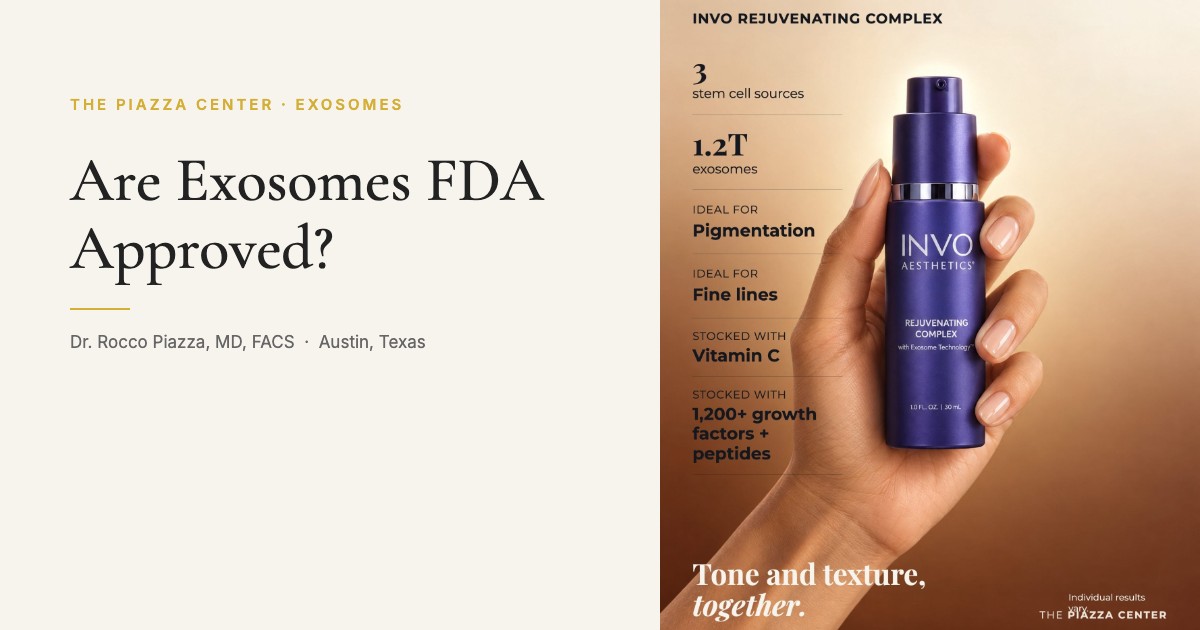
What we use daily: INVO Rejuvenating Complex, a topical exosome serum, AM and PM
Why This Matters: Both ingredients are sold as “regenerative”, and both now come as injectables and as serums. They are not the same thing, the evidence behind each is thinner than the marketing suggests, and what you get from a bottle is different from what you get from a needle. Knowing which is which keeps you from paying twice for the same promise. Individual results vary.
A few years ago nobody outside Korea asked me about salmon DNA. Now it is one of the most common questions in consultation, usually in the same breath as exosomes: which one should I be using, and is one of them a scam?
Neither is a scam, and neither is magic. They are two different ideas about how to tell tired skin to repair itself. One is a single, fairly well-understood signal. The other is a crowded envelope of signals. Here is how I explain the difference, and where each one earns a place.
Key Takeaways
- PDRN is salmon-derived DNA that acts mainly on the adenosine A2A receptor, a pathway tied to wound healing and calmer inflammation.
- Exosomes are cell-made vesicles that carry many signals at once; the human data is promising but small, and none are FDA-approved.
- They do different jobs, so using both is reasonable. For a daily topical, we use an exosome serum; injectables are a separate conversation.

Exosomes vs PDRN: The Short Answer
PDRN (polydeoxyribonucleotide) is purified salmon DNA that mainly activates one receptor, adenosine A2A, which is linked to wound repair and lower inflammation. Exosomes are vesicles released by cells that carry hundreds of proteins and other signals at once. PDRN is a targeted repair signal; exosomes are a broad one. Neither is FDA-approved as an injectable in the US, and both are sold in serums.
If you want one daily product for texture, tone and fine lines, an exosome serum with supporting actives is the more complete option. If you are considering injections in a clinic abroad, PN and PDRN have more injectable history than exosomes do. They are not rivals so much as different tools.
Ingredient A
PDRN / Polynucleotides
What it is: DNA fragments from salmon or trout sperm (PDRN) or testes (PN)
How it signals: One main receptor, adenosine A2A, plus spare nucleotides for repair
Best at: Calming, hydration, supporting repair; PN adds a gel-like scaffold when injected
Longest track record: Wound healing in Italy and Korea
US injectable status: Not FDA-approved
Ingredient B
Exosomes
What it is: Vesicles released by cultured cells, carrying proteins, lipids and RNA
How it signals: Many messages at once; the exact mix depends on the source cells
Best at: Broad support for texture, tone and post-procedure recovery
Track record: Newer; most human studies date from 2020 on
US status: No FDA-approved exosome products
Sources: Squadrito et al., Frontiers in Pharmacology 2017; Kim, Pharmaceutics 2025; Journal of Drugs in Dermatology 2026; FDA.
What PDRN and Polynucleotides Actually Are
Yes, it really is salmon sperm — or, more precisely, DNA extracted from it and purified so the proteins that could provoke an immune reaction are removed. A 2017 review in Frontiers in Pharmacology describes PDRN as a mixture of DNA fragments between roughly 50 and 1,500 kDa, taken from salmon sperm. (Frontiers in Pharmacology)
The mechanism is unusually specific for a cosmetic ingredient. PDRN binds the adenosine A2A receptor, which raises cAMP inside the cell, dials down inflammatory signalling and pushes up VEGF, the growth factor that builds new small blood vessels. It also feeds the “salvage pathway”, giving cells spare nucleotides to repair and copy DNA. A 2021 review in Pharmaceuticals lays this out and is honest that the molecular details are “still far from being fully understood.” (Galeano et al., Pharmaceuticals)
PN versus PDRN is mostly about chain length. Polynucleotides are longer chains, usually from fish testes, and form a thick, viscous gel. PDRN chains are shorter and less viscous. A 2025 review proposes that PN acts more as a structural, hydrating support under the skin, while PDRN behaves more like an active drug — and notes there is no standard molecular-weight cut-off, so brands use the terms loosely. (Kim, Pharmaceutics)
Why Everyone Is Suddenly Talking About Salmon DNA
PDRN is not new. Its roots are in 1980s wound-healing research in Italy. The Korean company PharmaResearch launched the polynucleotide injectable Rejuran in 2014, and its first topical ampoule in Korea in 2017. That K-beauty pipeline is what eventually crossed over to the US. (NewBeauty)
From wound care to your feed
1980s — PDRN studied for wound healing in Italy
2014 — Rejuran polynucleotide injectable launches in Korea
2017 — First Rejuran topical ampoule in Korea
2023–2024 — Celebrity mentions push “salmon sperm facials” into US headlines
2026 — Topical PDRN widely sold in the US; injectables still not FDA-approved
Sources: NewBeauty, July 2026; Salon, July 2024.
The celebrity moment did the rest. Kim Kardashian said on The Kardashians that she had salmon sperm injected into her face, and Jennifer Aniston said in 2023 that an aesthetician had introduced her to salmon sperm facials. (Salon) A celebrity trying something tells you it is available. It does not tell you it works for you.
In the US, PDRN injections would be regulated as a dermal filler, a Class III device, and they are not FDA-approved. (Cosmetics & Toiletries) What is widely sold here are topical serums, masks and creams.
What Exosomes Are, and What They Are Not
Exosomes are small vesicles that cells release to communicate with neighbouring cells. In skincare they are collected from cultured cells — fibroblasts, umbilical cord or bone marrow stem cells, platelets or plants, depending on the brand. There are no living cells in a serum bottle; INVO says so explicitly on its product page.
The appeal is breadth. Instead of one receptor, an exosome carries a mix of proteins, lipids and RNA. That is also the weakness: the mix varies with the source cells and the manufacturing, and there is no industry standard for measuring it.
The human evidence is early. A 2026 scoping review in the Journal of Drugs in Dermatology found 17 human studies from 2020 to 2025. Most reported improvement in wrinkles, pigmentation, elasticity or scarring, but the authors flag small samples, short follow-up and mostly non-randomised designs. (JDD) And per the FDA, there are currently no FDA-approved exosome products; the agency has issued public safety alerts about clinics marketing unapproved exosome products, after serious adverse events in patients. (FDA)
50–1,500
kDa
Molecular weight range of PDRN fragments
17
human studies
Exosomes in dermatology, 2020–2025
0
FDA-approved
Exosome products in the US
Sources: Frontiers in Pharmacology 2017; JDD 2026; FDA consumer alert.
Injectables vs Serums: Where the Difference Really Is
Most of the before-and-after photos people associate with salmon DNA come from injected PN, placed into the skin with a needle in Korean, European and Australian clinics. A serum is a different product with a different job. DNA fragments and vesicles are large molecules, and on intact skin they do not reach the same depth an injection does. NewBeauty quotes a dermatologist making exactly that point about topical PDRN. (NewBeauty)
That is why we pair topicals with procedures. Microneedling, laser and RF microneedling open temporary channels, and that is the window when a serum can get further in. In our practice we perform microneedling with exosomes, and I explain how that compares to a salmon DNA facial in Microneedling With Exosomes vs Salmon DNA Facial.
On ordinary days, a serum’s job is consistency: supporting the barrier, tone and fine lines over months, not weeks.

What Each One Is Good At
PDRN and PN are a good fit if your main concern is reactive, easily inflamed skin, dehydration, or recovery, and you like the idea of one well-described mechanism. Injected PN is widely used in Korea and parts of Europe, but it is not FDA-approved here.
Exosomes are a good fit if you want a broader daily product for fine lines, uneven tone and dullness, or support around procedures. Their weakness is variability between brands, which is why who makes the product and what they disclose matters so much.
Neither will lift lax skin, replace lost volume, remove excess eyelid skin or do what a laser does for deep wrinkles and sun damage. If that is what you are seeing in the mirror, a serum is the support act, not the treatment.
Can You Use PDRN and Exosomes Together?
Yes. They work through different routes, and nothing in the published literature suggests one blocks the other. To be clear, I am not aware of any study testing the two together, so “better together” is a reasonable idea rather than a proven one.
If you layer them, keep it simple:
- Cleanse gently.
- Apply the thinner product first, usually the PDRN essence or ampoule.
- Apply your exosome serum, morning and evening.
- Retinoid at night goes after the serum, then moisturiser. Sunscreen every morning.
Around procedures, follow the aftercare your provider gave you. Our day-by-day guide is What to Use After Laser, Microneedling or a Peel.
Video: Dr. Rocco Piazza (@roccopiazzamd) on which skincare trends stand the test of time.
"Patients ask me which is better, salmon DNA or exosomes, as if one has to lose. They do different jobs. PDRN is a narrow, well-described signal; exosomes are a broader one with earlier data. For a daily serum I want the broader support and a company that tells me what is in the bottle. For anything injected, I want FDA approval first." — Dr. Rocco Piazza, MD, FACS
The Exosome Serum We Use
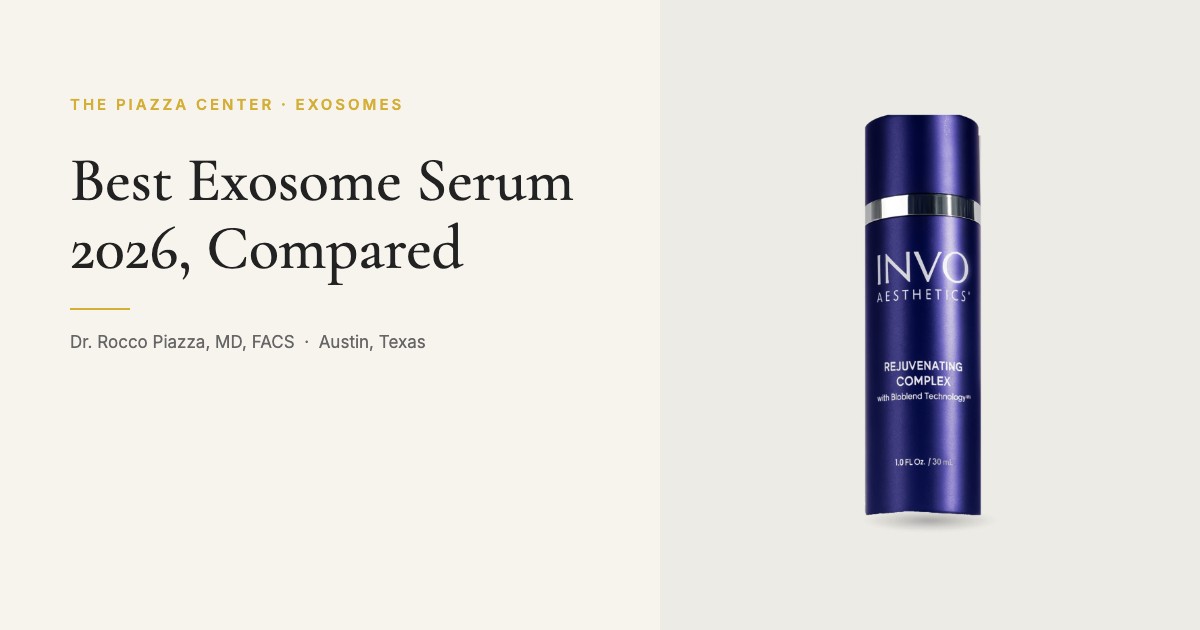
For a daily topical exosome serum, we use INVO Rejuvenating Complex (30 mL, $285, about $9.50 per mL). INVO states it contains more than 1.2 trillion exosomes and over 1,200 growth factors, proteins and peptides, with vitamin C and a peptide complex built in. INVO states its exosomes come from fibroblast, umbilical cord and bone marrow sources. We have not independently verified the counts.
What I like is practical. It is gentle enough to use right after microneedling, and after laser once your provider clears you. It replaces a separate vitamin C step for many patients. Use it morning and evening before moisturiser, put it on before your retinoid, and give it eight weeks.

What it cannot do: it will not lift, fill or resurface. For tired, crepey under-eyes, EXO EYE (NAD+, exosomes and peptides) is the eye-area option we stock. If you want to see how INVO compares with other premium serums, read INVO vs Young Goose vs SkinMedica TNS.
Exosomes vs PDRN: Common Questions
Is PDRN actually salmon sperm?
It is DNA extracted from salmon or trout sperm, then purified to remove proteins. You are not putting sperm on your face; you are applying refined DNA fragments.
Is PDRN better than exosomes?
Neither is better across the board. PDRN has a clearer single mechanism and a longer injectable history abroad. Exosomes carry broader signals but have earlier human data. They suit different goals, and individual results vary.
Can I use a PDRN serum and an exosome serum together?
Yes. Apply the thinner product first, then the exosome serum, then moisturiser. No study has tested the pairing directly, so introduce one at a time and watch how your skin responds.
Are salmon DNA injections FDA-approved?
No. In the US, PDRN injections would be regulated as dermal fillers and are not FDA-approved. There are also no FDA-approved exosome products. Topical serums are sold as cosmetics.
Does topical PDRN work as well as injections?
No. DNA fragments are large and do not reach the same depth through intact skin. Topical PDRN can support hydration and calm skin; injected PN is a different treatment.
How long until I see results from an exosome serum?
Give it about eight weeks of twice-daily use before judging. Texture and tone usually change gradually. Individual results vary.
I have a fish allergy. Can I use PDRN?
PDRN is purified, but it is still derived from fish. Talk to your physician before trying it, and patch test any new product.
Individual results vary. The products discussed are cosmetic products and are not intended to diagnose, treat, cure or prevent any disease. Exosome and growth factor figures are as stated by the manufacturer and have not been independently verified by The Piazza Center. No exosome product is FDA-approved. Cited studies are linked to their published sources. This article is for educational purposes and does not constitute medical advice; speak with a qualified physician about what is appropriate for your skin.
Salmon DNA, Exosomes, or Something Else Entirely?
Dr. Rocco Piazza and our Austin aesthetics team can look at your skin and tell you whether a serum, microneedling with exosomes or a laser will actually move the needle.

Dr. Rocco Piazza II
Board-Certified Plastic Surgeon
Dr. Piazza is a board-certified plastic surgeon practicing in Austin, TX. He specializes in aesthetic and reconstructive surgery with a focus on natural results.