



Expertly WRITTEN By
Dr. Rocco Piazza, MD, FACS
Board-Certified Plastic Surgeon & Austin's Specialist in Complex Breast Revision and Internal Bra Support.
The Case at a Glance
Patient: Woman, Age 39 · 5′1″, 124 lbs · third breast surgery
Desired Goal: Correct symmastia and bottoming out; restore separation with a fuller, more projected shape
Implant: Natrelle INSPIRA® SoftTouch Extra-Full Profile (SSX)
Size: 495cc
Technique: Pocket reconstruction, muscle repositioning, new subglandular pockets + GalaFLEX® internal support
Support Note: Symmastia and bottoming out are pocket problems, not implant problems. A new implant in the old pocket would have drifted back to the same place. Rebuilding the pockets fixed where the implants sit; GalaFLEX® reinforces the new pockets while her own tissue strengthens around them.
By the time this patient came to The Piazza Center, she had already had two breast surgeries: an augmentation in 2010 and an implant exchange in 2021. Neither had held. Over time her breasts had changed shape. There was a visible indentation on the left side, and the definition between her breasts had gradually disappeared.
On examination, the reason was clear. Both implants had shifted down and inward. They were sitting too low on the chest, a problem called bottoming out, and too close together, to the point where the breasts met across the center of the chest. That second problem has a name too: symmastia. She was 37 at that first visit, and she did not want a third surgery that simply swapped one implant for another. She wanted the position fixed for good.
What Is Symmastia (and Why Does It Happen)?
Symmastia is when the breasts appear to merge across the breastbone, with little or no natural gap between them. Sometimes called "uniboob" or "breadloafing," it can be congenital, but in patients with implants it is almost always a pocket problem.
Each implant sits in a pocket the surgeon creates. If that pocket extends too far toward the midline — or if the attachments of the chest muscle along the breastbone have been released — there is nothing holding the implants apart. Gravity, time and the weight of the implants do the rest, and the two pockets can gradually drift toward, or even into, each other.
Bottoming out is the same kind of failure in a different direction. The lower edge of the pocket stretches below the natural breast crease, and the implant slides down with it. The nipple then sits too high on the breast, the upper breast looks empty, and the implant can be felt or seen low on the chest. This patient had both problems at once, which is why a straightforward exchange was never going to be enough. Our overview of the most common complications after breast implants covers how these issues are usually spotted.
Why a New Implant Alone Would Not Fix It
Most patients with symmastia or bottoming out assume the fix is a different implant. It isn't. If you put a new implant into the same overstretched pocket, it goes exactly where the last one went. The position problem lives in the pocket, so the pocket is what has to be repaired.
For this patient, breast revision meant three structural steps before implant choice even came into it:
- Reconstruct the breast pockets. The oversized, merged pockets were rebuilt so each breast once again had its own defined space.
- Reattach the chest muscle. The previously released pectoralis muscle was repositioned back against the chest wall, restoring the natural barrier along the midline.
- Create new subglandular pockets. Fresh pockets were made in a new, unscarred plane, allowing Dr. Piazza to set each implant's position precisely, with proper separation between the breasts and a correct lower border.
GalaFLEX®: Reinforcing the New Pockets
Rebuilding a pocket fixes position on the day of surgery. The challenge in revision is keeping it there, because the tissue that stretched once can stretch again. That is where GalaFLEX® comes in.
GalaFLEX® is a surgical scaffold made from poly-4-hydroxybutyrate (P4HB), often called an internal bra. It was placed to reinforce the new pockets and give the implants additional support. It is not a permanent mesh: over roughly 12 to 18 months the scaffold is gradually resorbed, and the body lays down its own collagen along the same framework. What stays behind is the patient's own reinforced tissue. For a woman on her third operation, that extra support is what gives the correction something to hold onto. We explain the scaffold in more depth in our GalaFLEX internal bra case study.
The Implant: 495cc Natrelle INSPIRA® SoftTouch SSX
With position solved, she could choose her result. She wanted a fuller, more projected look, so her implants were exchanged for 495cc Natrelle INSPIRA® SoftTouch Extra-Full Profile (SSX) silicone gel implants from Allergan.
The Extra-Full profile projects further forward from its base than lower-profile options, which adds fullness and shape to the front of the breast rather than pushing volume toward the center or sides. On a 5′1″ frame, that forward projection is how she gained volume while keeping clear separation between her breasts. The SoftTouch gel is formulated to hold its shape while still feeling soft. Compare profiles and gel types in our guide to breast implant options in Austin.
Clinical Results: Symmastia and Bottoming Out Corrected
Tap any image below to reveal this patient's actual result — restored separation between the breasts, implants raised to a natural position, and fuller projection. See more breast revision cases in our gallery.
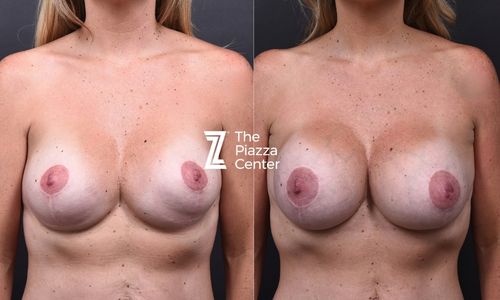
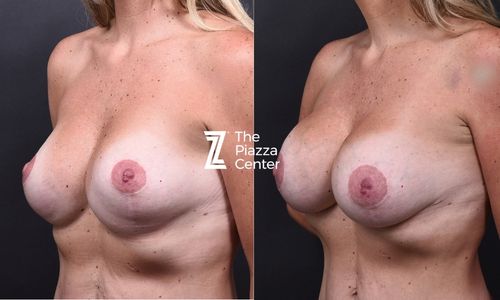
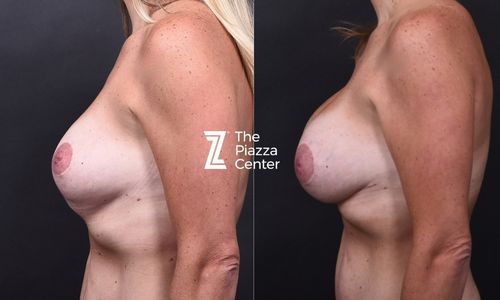
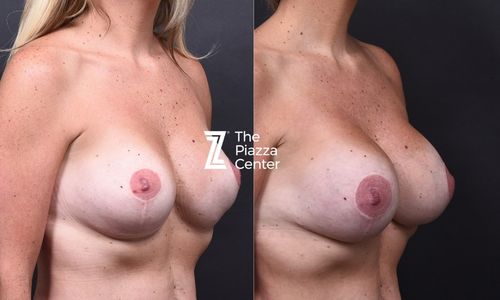
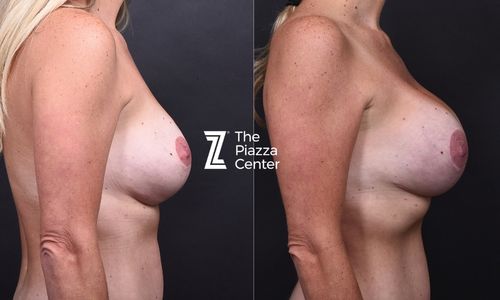
The difference is in the structure. Each breast now has its own defined space, with visible separation across the center of the chest. The implants sit higher, at a natural position on the chest, and the Extra-Full profile gives her the fuller, more projected shape she wanted.
Signs You May Need Symmastia or Bottoming Out Repair
- Your breasts touch or merge in the middle, with little or no gap over the breastbone.
- Your implants sit low, with the nipples pointing upward and the upper breast looking empty.
- You can see or feel the implant edge below your breast crease or near your breastbone.
- Your shape has changed gradually since your augmentation or last exchange.
- A previous revision did not hold, and the implants have drifted back toward the same position.
"When implants drift together or bottom out, patients usually think they need a different implant. What they need is a different pocket. Once the pockets are rebuilt and supported, the implant can finally stay where it belongs." — Dr. Rocco Piazza
Symmastia & Bottoming Out Repair FAQ
What causes symmastia after breast augmentation?
In patients with implants, symmastia usually happens when the implant pockets extend too far toward the midline, or when the chest muscle's attachments along the breastbone have been released. Without that barrier, the implants can drift toward each other over time until the breasts appear to merge.
Can symmastia be fixed?
Yes. Repair focuses on the pocket, not just the implant. Depending on the case, that can mean tightening or rebuilding the pockets, reattaching muscle along the breastbone, moving the implants to a new pocket plane, and adding internal support such as GalaFLEX®. In this case, Dr. Piazza used all of those steps.
What is bottoming out, and is it the same as symmastia?
No. Bottoming out is when the implant slides below the natural breast crease, so it sits too low and the nipple points upward. Symmastia is when the implants sit too close together in the middle. They are different directions of the same kind of pocket failure, and some patients, like this one, have both.
Will I need GalaFLEX for a breast revision?
Not always. Internal support is most helpful when the tissue has already stretched once, as in bottoming out, symmastia or a failed prior revision. GalaFLEX® resorbs over about 12 to 18 months and is replaced by your own collagen, reinforcing the new pocket. Dr. Piazza decides whether you need it after an in-person exam.
Can I go bigger during a revision?
Often, yes, once the pocket problem is corrected. This patient moved to 495cc Natrelle INSPIRA® SoftTouch Extra-Full Profile implants for more fullness and projection. The right size depends on your tissue, frame and how much support the new pockets can provide, which is why the pocket repair and the implant choice are planned together.
Individual results vary. Photographs are of an actual patient of The Piazza Center, published with consent. This article is for educational purposes and does not constitute medical advice. Consult a board-certified plastic surgeon to determine whether a procedure is right for you.
Are Your Implants Too Low or Too Close Together?
Dr. Rocco Piazza specializes in complex breast revision, including symmastia and bottoming out repair with internal support. Find out what it would take to fix your implant position for good.
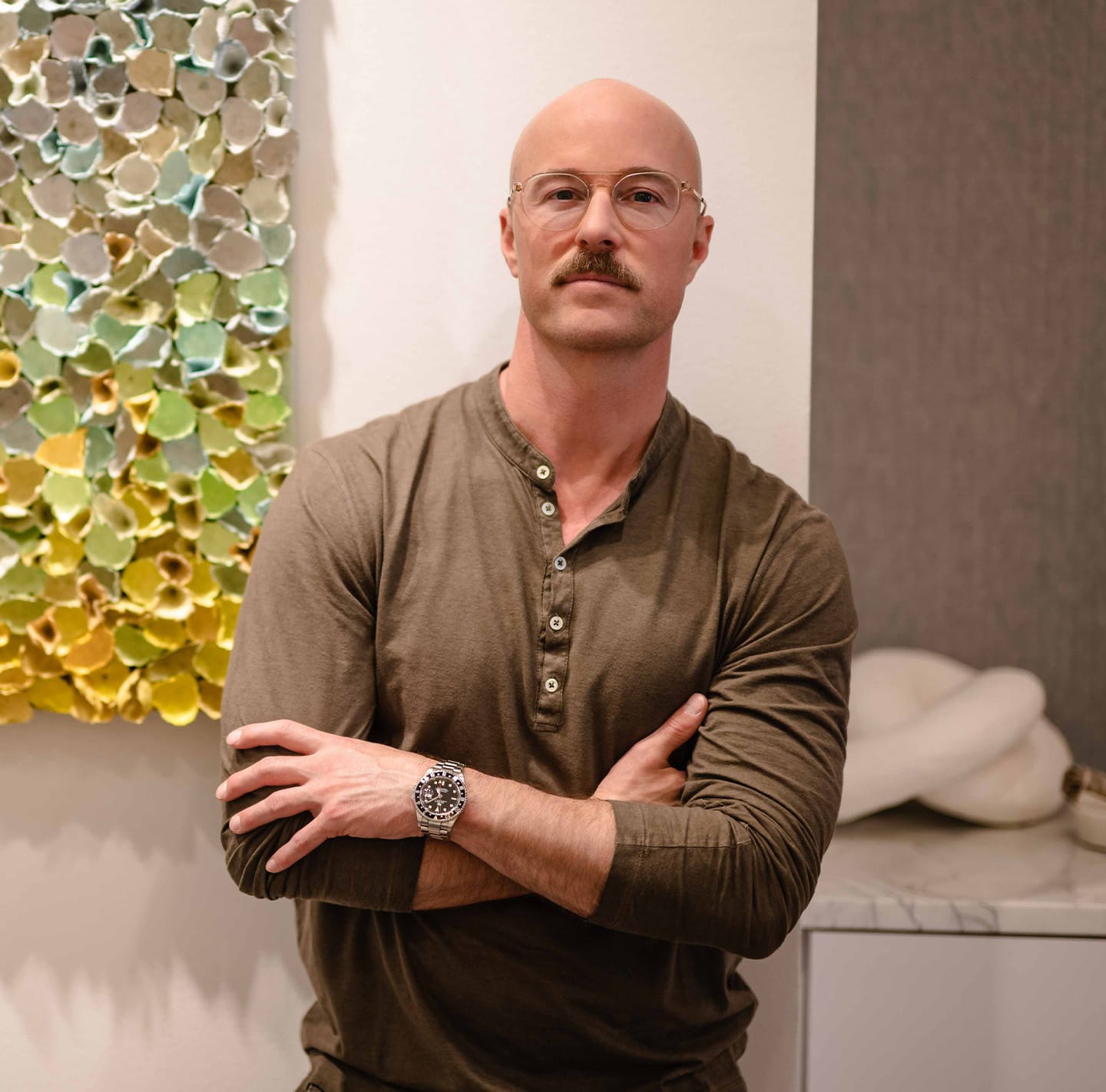
Dr. Rocco Piazza II
Board-Certified Plastic Surgeon
Dr. Piazza is a board-certified plastic surgeon practicing in Austin, TX. He specializes in aesthetic and reconstructive surgery with a focus on natural results.