


Expertly WRITTEN By
Dr. Rocco Piazza, MD, FACS
Board-Certified Plastic Surgeon & Austin's Leading Provider of Motiva Preservé™ Tissue-Preserving Breast Augmentation.
The Case at a Glance
Patient: Mother of two, Age 26 · 5′2″, 105 lbs
Desired Goal: Restored upper fullness — natural, not overly augmented
Implant: Motiva Ergonomix® Full
Size: 275cc
Technique: Preservé™ (Tissue Preservation)
Sizing Note: On a petite frame, the implant's base width — not its cc number — decides whether a result looks natural. 275cc was chosen to fit the width of her chest, and the Full profile supplies the upper-breast fullness she wanted without widening the breast past her frame.
"How big can I go without looking fake?" is the question petite women ask most in a breast augmentation consultation — and it is the right question. At 5′2″ and 105 pounds, there is very little margin for error. An implant that would look subtle on a taller, broader woman can overwhelm a small frame, and one that is too timid can leave a patient wishing she had gone fuller.
This 26-year-old mother of two came to The Piazza Center to restore the volume she lost after pregnancy and breastfeeding. Her priority was proportion. She wanted her upper breast fullness back and a more lifted look, but she did not want anyone to look at her and think "implants." Dr. Piazza performed a Motiva Preservé™ breast augmentation using 275cc Motiva Ergonomix® Full implants — a fuller result than most of the cases we have shared, on one of the smallest frames.
Why CCs Mean Something Different on a Petite Frame
Implant volume gets most of the attention, but volume alone tells you very little. The same 275cc implant can look modest on one woman and dramatic on another, because what the eye reads is how the implant sits on the chest — its base width and its projection.
On a narrow chest, the base width is the hard limit. An implant wider than the patient's natural breast footprint spills toward the armpit or crowds the cleavage, and that is what makes a result look augmented. So for petite patients, Dr. Piazza starts by measuring the width of the breast and chest, chooses a base width that fits inside it, and only then looks at how much volume and projection that width can carry. The cc number is the last decision, not the first.
That is why "what size should I get?" rarely has a universal answer. For comparison, our 150cc Motiva "ballerina" case and our 205cc post-pregnancy case were planned the same way — frame first, volume second — and each landed somewhere different.
Why a Full Profile Instead of Demi
Motiva Ergonomix® implants come in several projections, including Demi and Full. Most of the natural-look cases on our blog use the Demi profile, which keeps projection soft and low. For this patient, the Full profile was the better tool.
Her main concern after two pregnancies was the upper breast: the fullness above the nipple that deflates after breastfeeding. A Full profile implant projects further forward from the same base width. On a narrow chest, that means Dr. Piazza could restore upper-pole fullness and a lifted look without choosing a wider implant. More projection, same footprint — which is exactly what a petite frame needs.
The Ergonomix® gel matters here too. It is designed to shift with the body — rounder at the top when she is upright, softer when she lies down — so the added projection still moves and settles like natural breast tissue. You can compare profiles and gel types in our guide to breast implant options in Austin.
How Motiva Preservé™ Protects a Petite Result
With thin tissue and little natural coverage, the way the implant is placed matters as much as which implant is chosen. Motiva Preservé™ is a tissue-preserving approach: the pocket is created through a small incision with as little disruption to the surrounding breast tissue and muscle as possible, rather than broadly releasing structures to make room.
Preserving that tissue is what keeps the implant well covered and sitting where it was placed. For a patient with a small frame, that coverage is what separates a soft, natural transition from a visible implant edge. It is also why many Preservé patients describe a gentler recovery — you can read more in our Motiva Preservé recovery timeline.
Clinical Results: 275cc on a 5′2″ Frame
Tap any image below to reveal this patient's actual result — restored upper fullness and a proportionate shape on a petite frame. See more Motiva Preservé cases in our gallery.
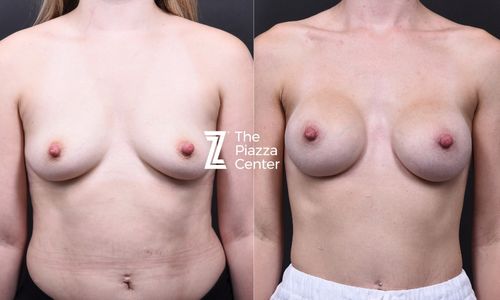
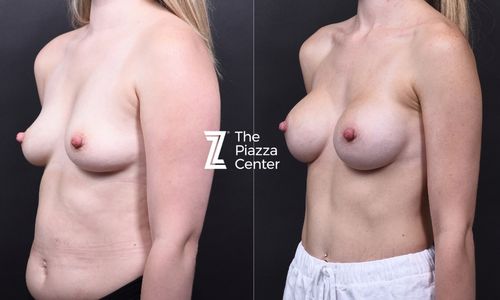
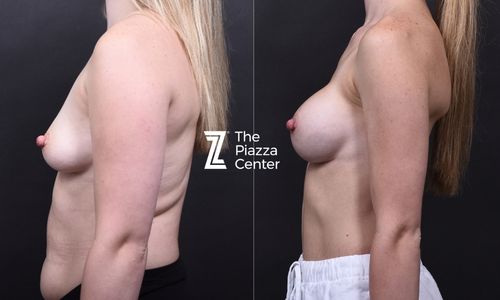
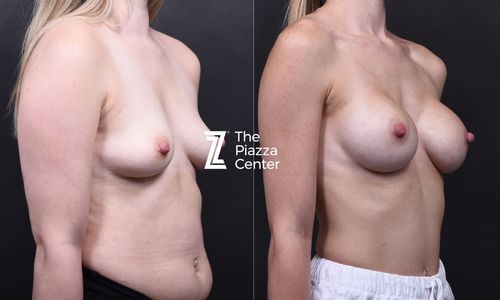
What stands out is proportion. Her upper breast fullness is restored and the shape reads as lifted, yet the breasts stay within the width of her chest, so the result complements her frame rather than dominating it. She achieved this without a breast lift.
What This Case Means If You Are Petite
- You are not limited to "tiny." A small frame calls for careful measurement, not automatically the smallest implant.
- Width comes first. Choosing a base width that fits your chest is what keeps a fuller result natural.
- Projection is the lever. A Full profile adds upper fullness without making the breast wider.
- Technique protects the result. Preserving tissue keeps thin coverage intact over the implant.
- Pregnancy changes the plan. Volume loss after breastfeeding often sits in the upper breast, which is what the right profile restores.
"Petite patients don't need to be told to go small. They need an implant that fits the width of their chest. Once the footprint is right, projection is how we give them the fullness they came in for, and it still looks like it belongs to them." — Dr. Rocco Piazza
Petite Breast Augmentation FAQ
What size breast implant is right for a petite woman?
There is no single number. The right size starts with the width of your chest and breast, which sets the maximum base width an implant can have. Volume and projection are then chosen within that width. This patient, at 5′2″ and 105 pounds, was a good fit for 275cc, but another petite patient could be best served by 150cc or 300cc.
Will 275cc look too big on a small frame?
Not when the implant is matched to the frame. Whether an implant looks "too big" depends mostly on its base width and projection relative to your chest, not the cc number alone. In this case, a Full profile implant with a base width sized to her chest produced a natural, proportionate result.
What is the difference between Motiva Ergonomix Demi and Full?
Both are Motiva Ergonomix® implants; the difference is projection, or how far the implant extends forward from the chest. Demi is softer and lower, and Full projects further. A Full profile can add more upper fullness from the same base width, which is often useful on a narrow chest.
Do I need a breast lift after pregnancy, or just implants?
It depends on where your nipple sits relative to the breast crease. If nipple position is still good and the change is mainly lost volume, implants alone can restore shape, as they did here. If the nipple has descended significantly, a lift may be part of the plan. That decision needs an in-person exam.
Is Motiva Preservé a good option for thin patients?
Often, yes. Thin patients have less natural tissue covering the implant, so a technique that preserves that tissue helps keep the result soft and well covered. Read more about who is a good candidate for Motiva Preservé, and Dr. Piazza will confirm your fit at consultation.
Individual results vary. Photographs are of an actual patient of The Piazza Center, published with consent. This article is for educational purposes and does not constitute medical advice. Consult a board-certified plastic surgeon to determine whether a procedure is right for you.
Petite and Wondering What Size Fits You?
Dr. Rocco Piazza plans every Motiva Preservé™ augmentation around your frame, not a number. See what a natural, proportionate result could look like for you.
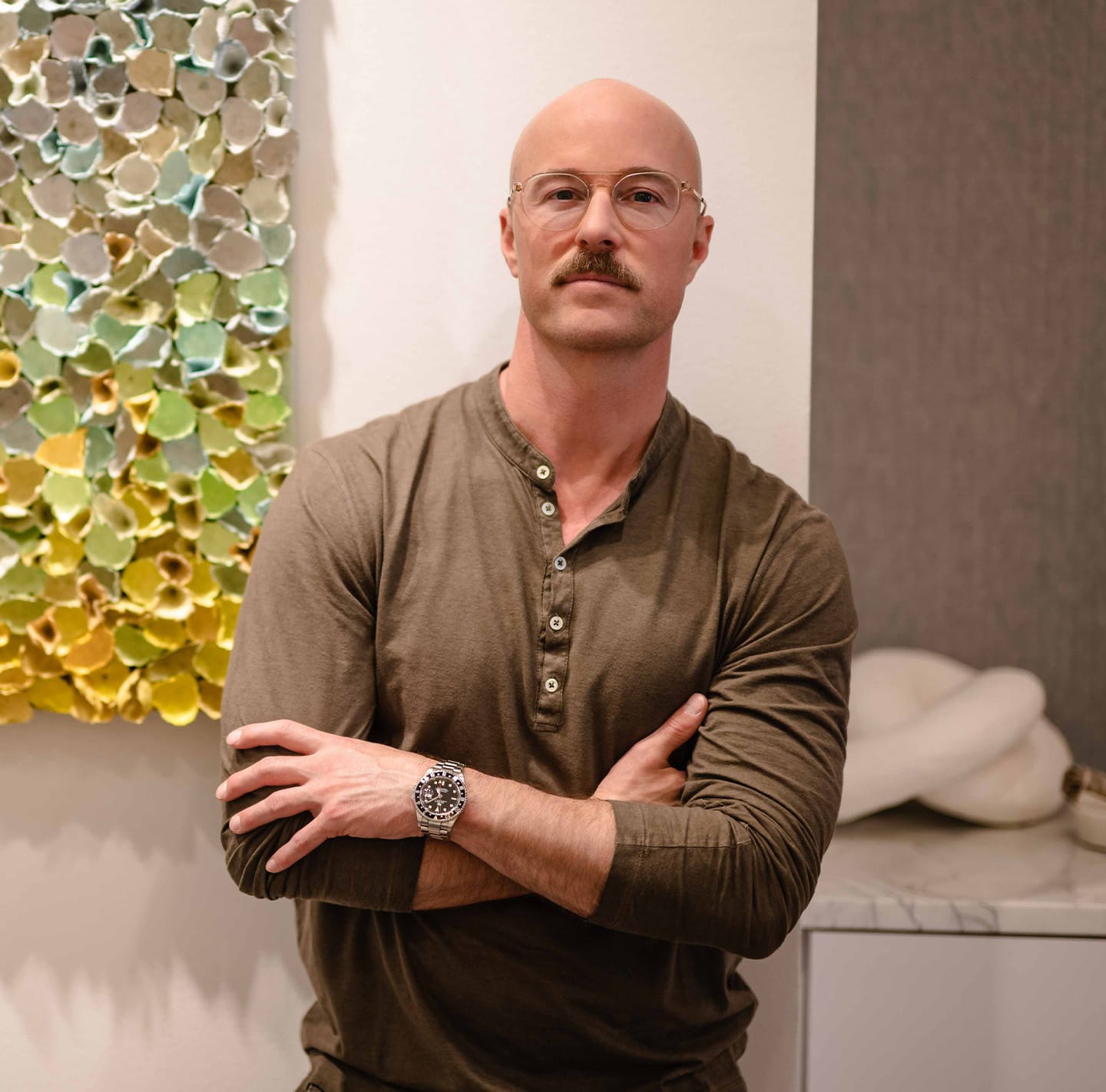
Dr. Rocco Piazza II
Board-Certified Plastic Surgeon
Dr. Piazza is a board-certified plastic surgeon practicing in Austin, TX. He specializes in aesthetic and reconstructive surgery with a focus on natural results.