


Dr. Rocco C. Piazza, MD, FACS
Board-certified plastic surgeon · The Piazza Center, Austin, Texas
Medically reviewed · Updated September 2026
Search “what to use after laser resurfacing” and nearly every clinic in the country gives you the same four things: a gentle cleanser, an occlusive ointment, vinegar soaks, sunscreen.
That advice is not wrong. It is wound care, and wound care is the first week.
It is not, however, a protocol. Ablative and fractional resurfacing — ContourTRL, ProFractional, HALO — does not simply injure the surface. It removes tissue on purpose so your skin rebuilds it. The result you paid for is not the healing. It is the rebuilding underneath it, over the weeks and months that follow.
Almost nobody tells you what to put on skin during that part. This is what we use, in order, and why.

What actually happens after ContourTRL, ProFractional or HALO
ContourTRL and Erbium ProFractional are Erbium YAG resurfacing lasers — ContourTRL treats the full surface, ProFractional goes deeper in columns. HALO pairs a fractional ablative wavelength with a non-ablative one. All of them remove or damage tissue on purpose, which sets off three overlapping phases:
- Days 0–7 — re-epithelialization. The skin closes. This is the phase every aftercare sheet covers: keep it clean, keep it moist, do not pick, take the antiviral. Redness, swelling and pinpoint bleeding are expected.
- Weeks 1–4 — remodeling. The surface has closed, but the extracellular matrix underneath is being actively rebuilt. Fibroblasts are laying down new collagen. This is the phase that decides your result, and almost no one gives you a product strategy for it.
- Months 1–6 — maturation. New collagen organizes and tightens. Sun exposure here can undo real results, and post-inflammatory pigmentation shows up in this window if it is going to.
Ointment belongs in phase one. The interesting decisions are in phase two.
What faster healing actually looks like
This is Pavise’s own clinical photography following ablative Erbium YAG resurfacing — the same wavelength family as ContourTRL and ProFractional. Left is immediately post-procedure. Right is four days later.
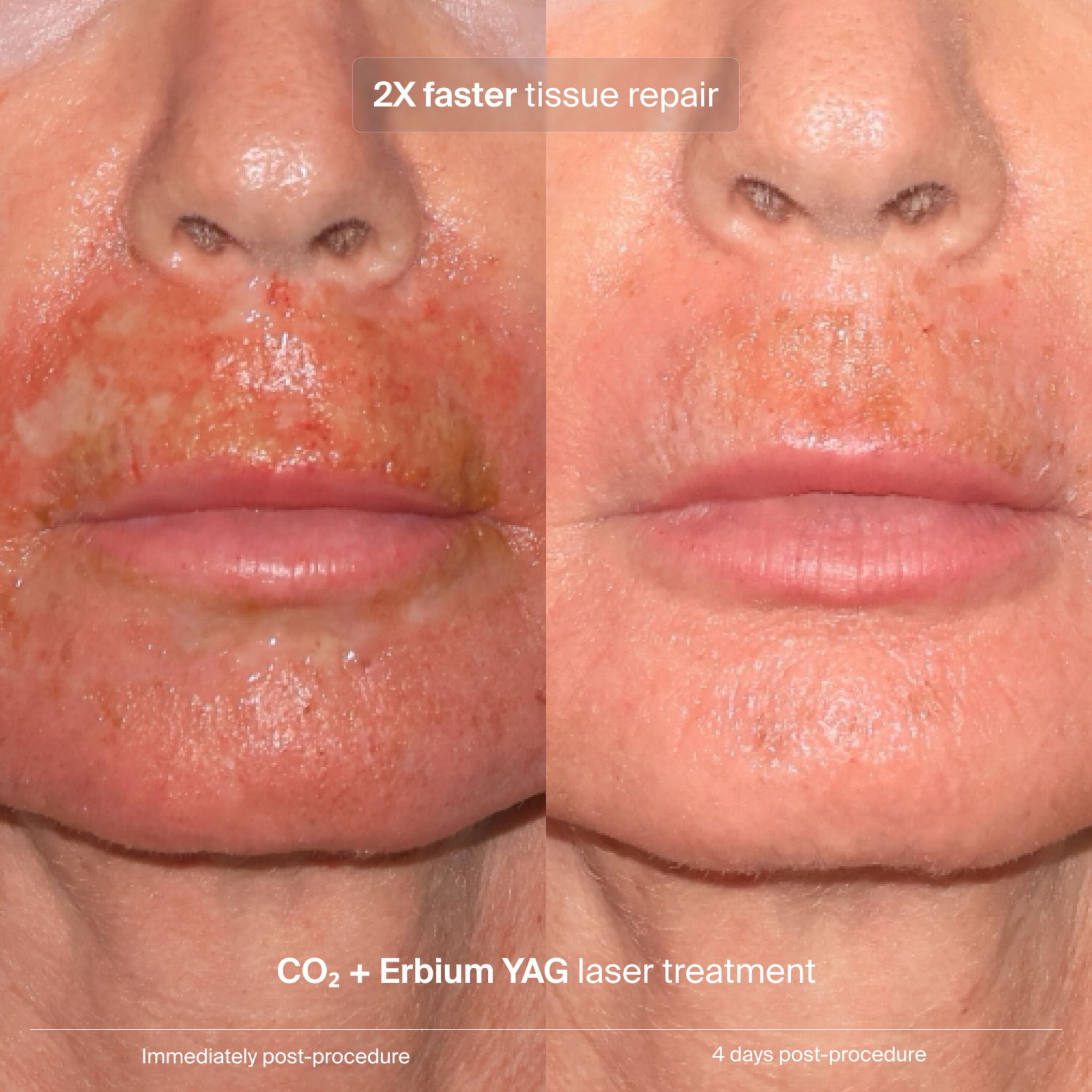
Four days is not a cosmetic milestone. Less time with open, inflamed skin means less opportunity for the inflammation that drives post-inflammatory hyperpigmentation — and a shorter stretch where a fresh result is fragile and easy to compromise.
The protocol we use
Day 0 onward — ECM Restore, and nothing else
Immediately after treatment the skin is open and the priority is singular: support the matrix while it rebuilds. Pavise Extracellular Matrix Restore is the only product that goes on at this stage. No actives, no layering, no experimenting.
It is a post-treatment matrix activator formulated for sensitive and post-procedure skin, and it is the subject of a registered clinical trial (ClinicalTrials.gov NCT07462533) evaluating it as the primary occlusive treatment immediately following ablative CO2 and Er:YAG facial resurfacing — the same Erbium YAG wavelength family we treat with.
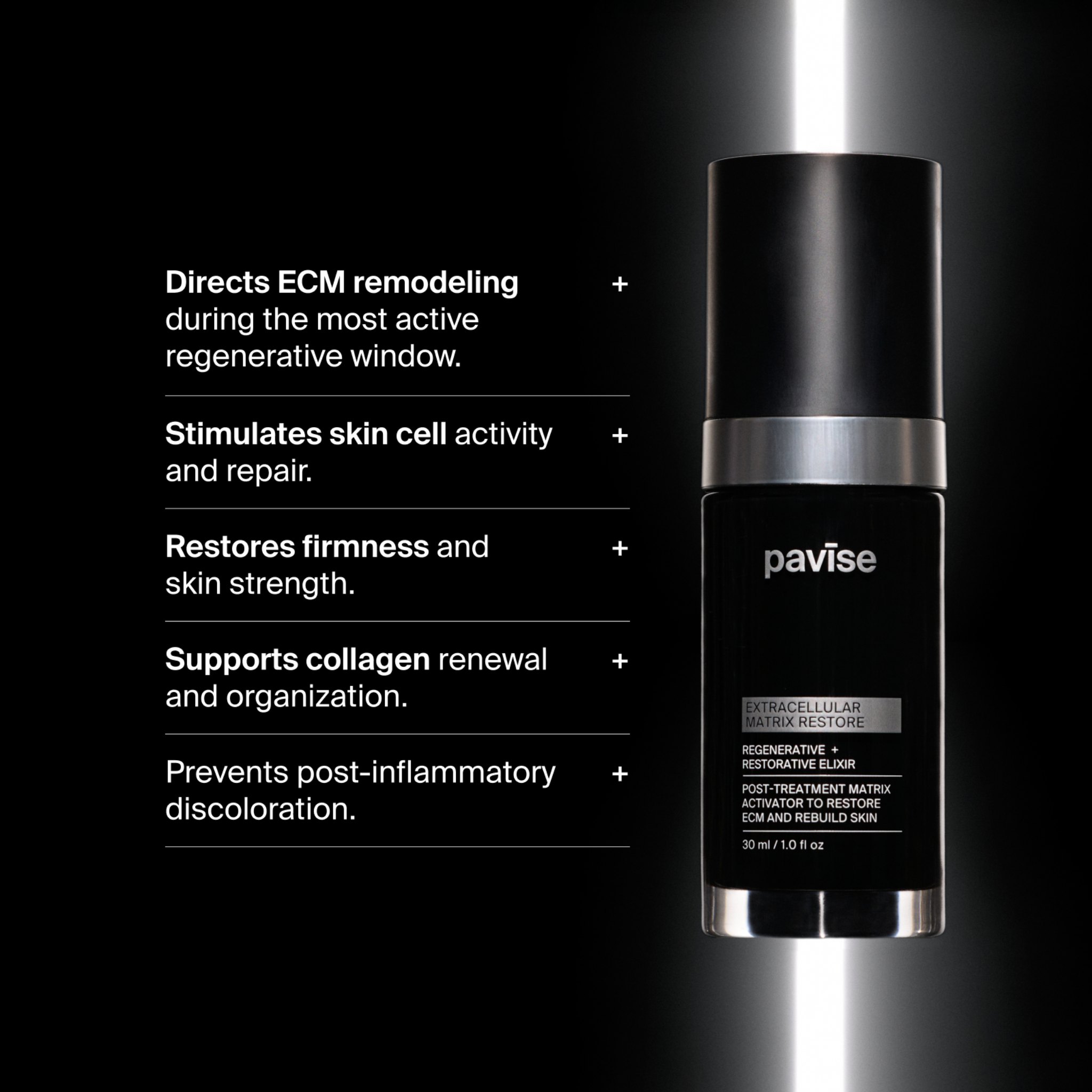
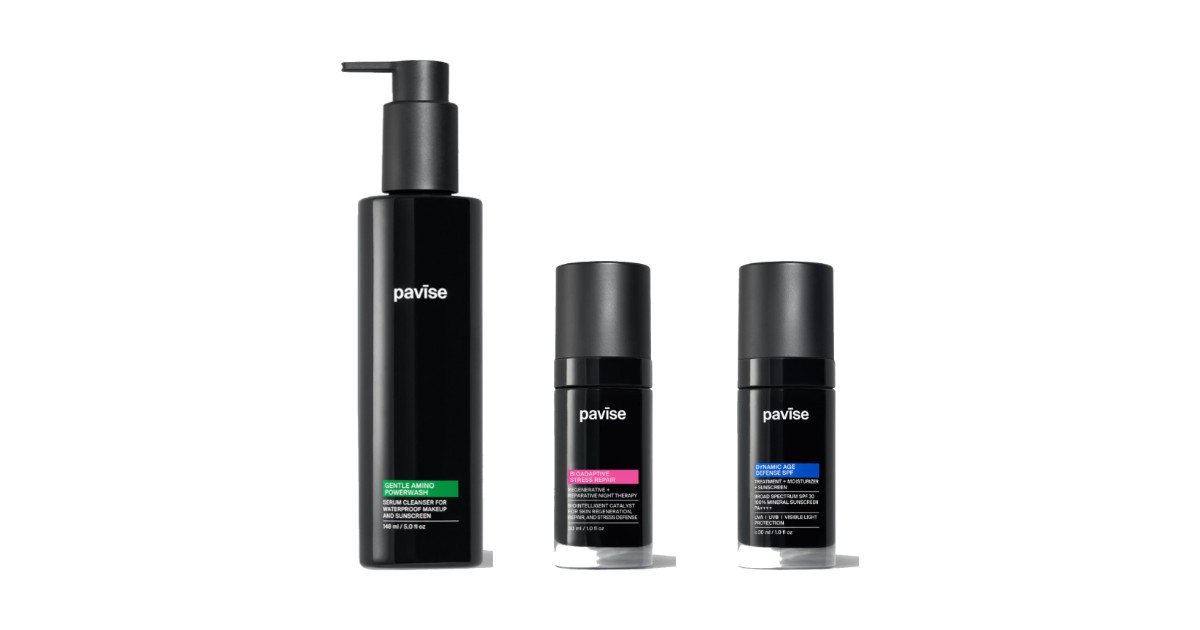
Pavise Extracellular Matrix Restore
Post-procedure matrix activator, 30 ml · $278
Shop Pavise Extracellular Matrix Restore →
Day 2 — add Dr. Medion Spaoxy Gel
Carboxy therapy to cool and calm the treated skin. It comes in on day two, not before. Patients consistently describe it as the point where the tightness eases.
Day 3 onward — add SPF
From day three, sunscreen joins the protocol and never leaves it. This is the least negotiable item on the list. Sun exposure across the months of remodeling is the fastest way to lose what the laser bought you, and it is the primary driver of post-inflammatory pigmentation.
Use a mineral SPF. A tinted mineral formula has a practical advantage in the first weeks: it camouflages residual redness while it protects.
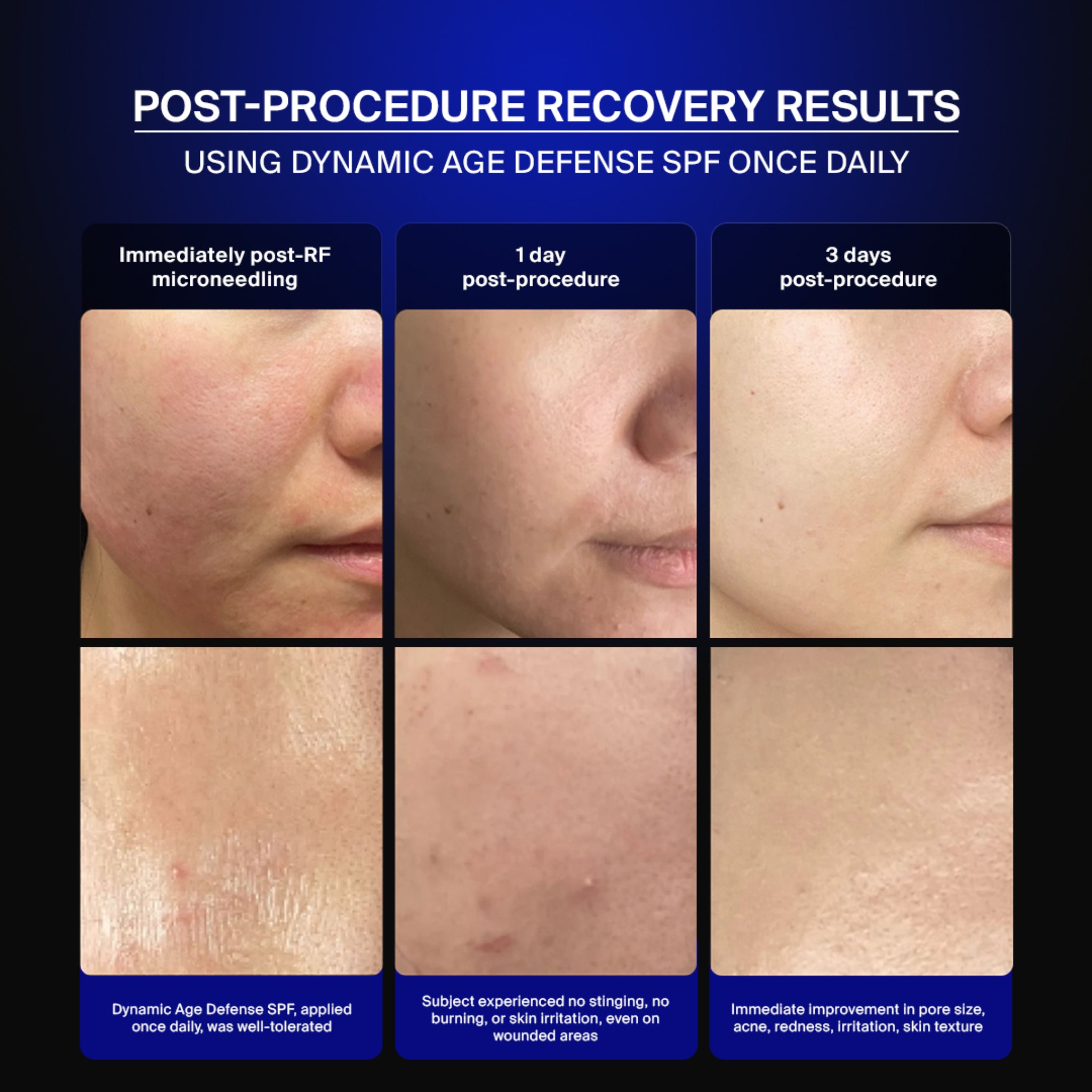
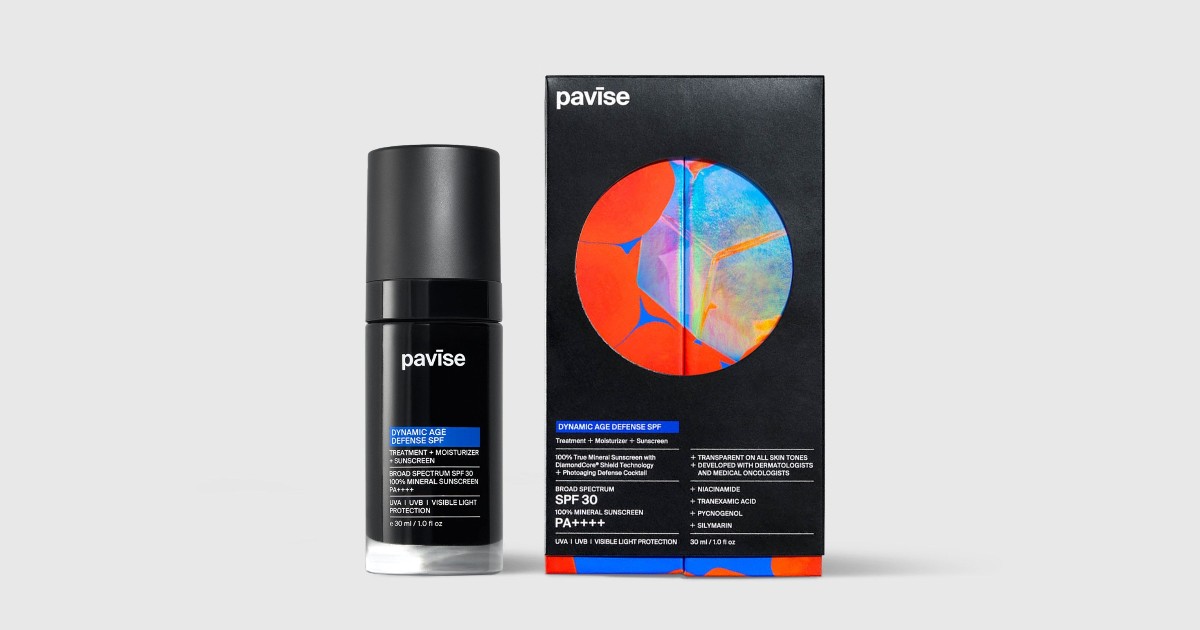
Pavise Dynamic Age Defense SPF 30
100% mineral, PA++++, visible light protection, 30 ml · $148
Shop Pavise Dynamic Age Defense SPF 30 →
Once healed — cleansing that does not undo the work
You will now be wearing mineral sunscreen every day, and mineral filters are designed to sit on the skin rather than sink in — which is exactly why an ordinary cleanser struggles to remove them. The common fix is to wash twice. Two rounds of surfactant on freshly remodeled skin is how a barrier gets stripped.
We use a cleanser built to take mineral SPF off in a single pass instead.
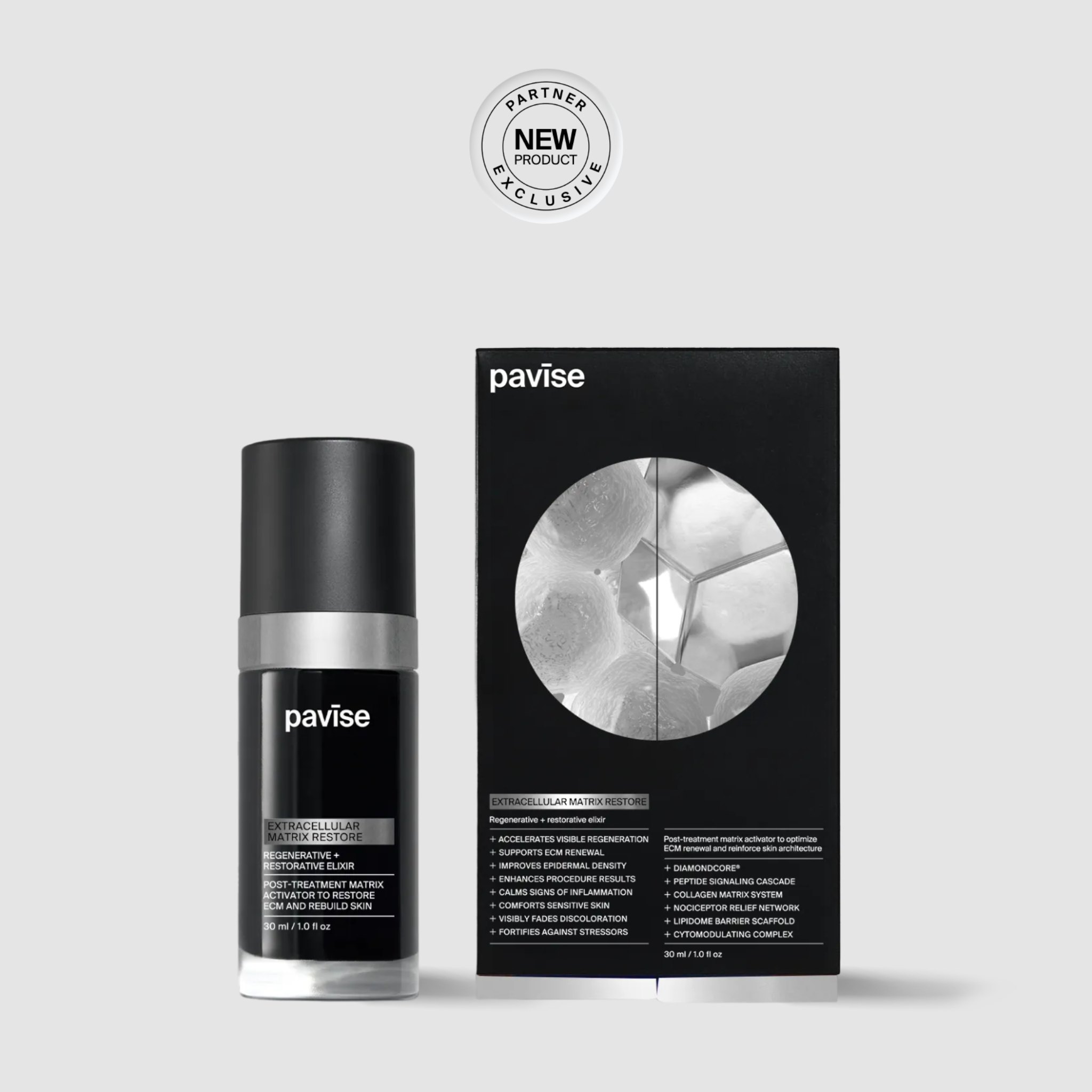
Pavise Gentle Amino Powerwash
Serum cleanser, removes mineral SPF in one pass, 148 ml · $64
Shop Pavise Gentle Amino Powerwash →
Alastin Skin Nectar vs. Pavise ECM Restore
This is the comparison patients ask us for most, so here is the direct version.
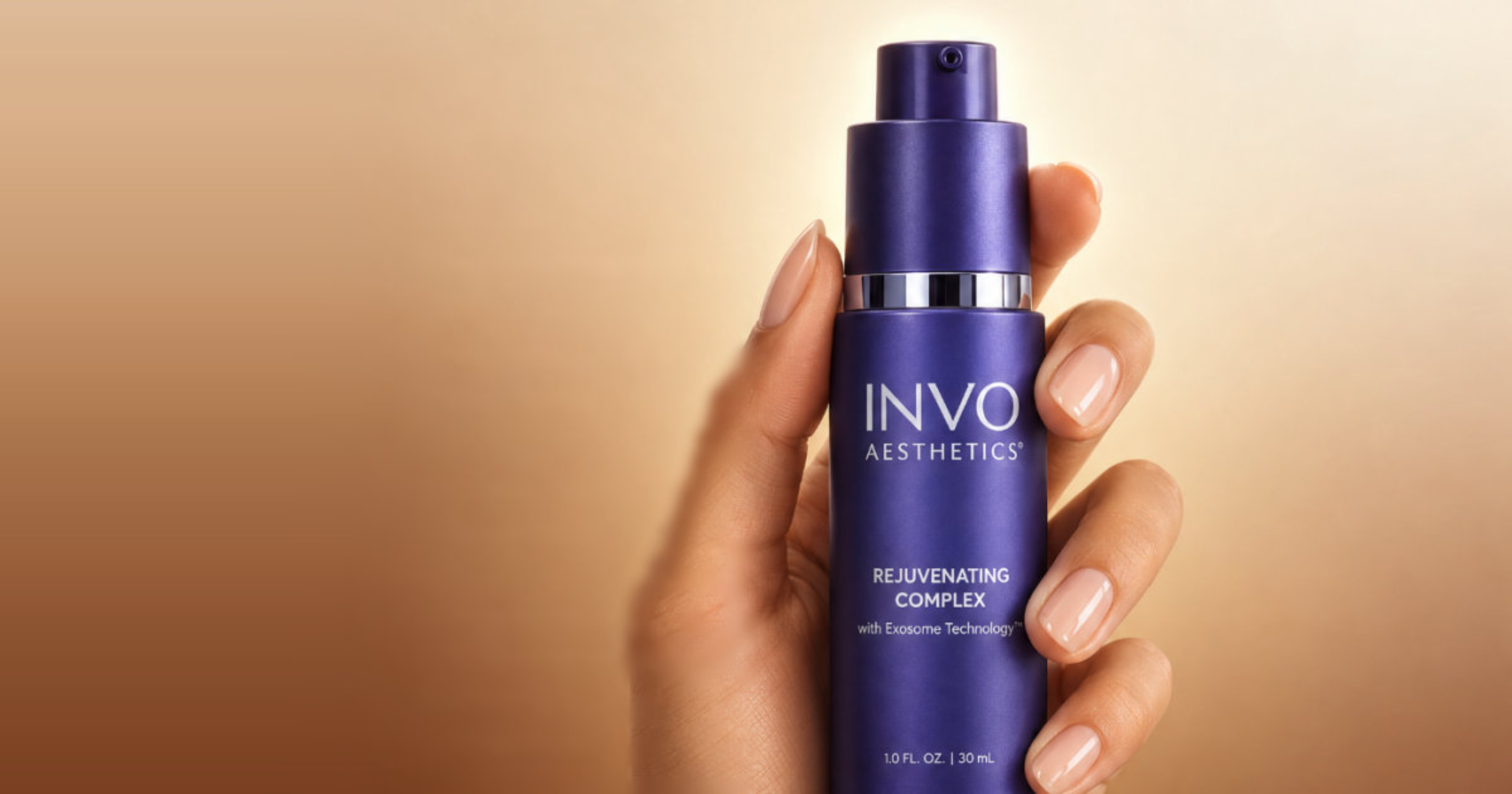
Alastin Regenerating Skin Nectar is built on TriHex Technology — a tripeptide and hexapeptide pairing designed to help clear out degraded collagen and elastin fragments so new proteins have room to be laid down. When it launched that was a genuinely novel idea, and it became the default post-procedure serum in plastic surgery offices for most of a decade. It earned that.
Pavise Extracellular Matrix Restore comes at the same window from the other end. Rather than focusing on clearing the old matrix, it is formulated to direct the rebuild itself — supporting how new collagen is organized while fibroblast activity is at its peak.
The honest summary: they are two generations of the same idea. One clears the site. The other conducts the construction.
| Alastin Skin Nectar | Pavise ECM Restore | |
|---|---|---|
| Core idea | Clear degraded collagen and elastin to make room | Direct matrix remodeling as it rebuilds |
| Technology | TriHex peptides | DiamondCore®, human collagen III, peptide signaling cascade |
| Generation | The 2015-era standard | Current generation |
| Registered trial on ablative laser | — | Yes — NCT07462533, CO2 and Er:YAG |
| When we start it | Typically once skin has closed | Day 0 |
If you are mid-recovery on Skin Nectar and your skin is happy, finish it. Switching products in the middle of a healing window for the sake of switching is not a strategy. If you are choosing now, we are pointing patients to ECM Restore.
What does not belong in laser recovery
One correction worth making, because we hear it constantly: silicone scar gels are not laser aftercare. Silicone sheeting and gels are excellent for surgical incisions — and they go on after the incision has healed. A resurfaced face is a different problem with a different biology. Using a scar product on it does not help and can trap heat and occlude skin that needs to breathe.
Retinoids, acids, vitamin C and physical exfoliation all wait. Your care team will tell you when each one comes back.
Why we are particular about this

The Piazza Center is a board-certified plastic surgery practice in Austin, Texas, led by Dr. Rocco Piazza, MD, FACS. Our resurfacing and light treatments — ContourTRL, Erbium ProFractional, HALO, Moxi and BBL HERO — are performed by our clinical nursing team, and that same team follows you through the entire recovery rather than handing you a printout on the way out.
That continuity is why this list is short. We are not reading product claims off a page. We watch how skin behaves over the following six months, on our own patients, after our own treatments, and we restock accordingly.
Frequently asked questions
What is the best product to use after ContourTRL or ProFractional?
It depends on the day. From day zero, a post-procedure matrix activator such as Pavise ECM Restore, on its own. Day two, carboxy therapy is added to calm the skin. From day three, mineral SPF joins and stays permanently. Once you are healed, a non-stripping cleanser protects the barrier while you wear sunscreen daily.
How is ContourTRL recovery different from HALO or Moxi?
Depth. ContourTRL and Erbium ProFractional are ablative Erbium YAG and take the longest to re-epithelialize; HALO is fractional and lighter; Moxi is lighter still. Lighter still again are MicroLaserPeel and NanoLaserPeel. The biology is the same sequence in every case — only the timeline compresses. Expect roughly 7 to 10 days of visible downtime for a moderate treatment and up to two weeks for an aggressive one, with redness that can persist longer.
How long does redness last after ablative resurfacing?
Commonly 10 to 14 days, and longer after deeper treatments. Redness that is worsening rather than gradually improving is worth a call to your provider.
Can I use Alastin Skin Nectar after a laser?
Yes, and many practices do. It is the previous generation of post-procedure technology — designed to clear degraded matrix proteins rather than direct the rebuild. We now start patients on ECM Restore instead, from day zero.
Should I use silicone scar gel after laser resurfacing?
No. Silicone gels are for surgical incisions, after they have healed. They are not part of a laser recovery protocol.
When can I wear makeup again?
Only once the skin has fully closed and your provider clears you. Applying makeup over skin that is still re-epithelializing risks both infection and a worse cosmetic outcome.
When can I restart retinol after laser resurfacing?
Well after the skin has closed, and on your care team’s timeline rather than a general guideline. Restarting actives early is one of the more common ways patients set their own recovery back.
Shop the full Laser Recovery Protocol →
Every product in this article, in the order we use it.
Individual results vary. Product data and clinical photography supplied by Pavise and presented unmodified with their timepoints intact. ClinicalTrials.gov identifier NCT07462533 is a registered, ongoing study; registration is not a finding of efficacy. This article is for educational purposes and does not constitute medical advice.
Planning a resurfacing treatment?
Talk to our team about which laser fits your skin and your calendar — and we will build the recovery protocol around it before you book.
Book a ConsultationMore from the blog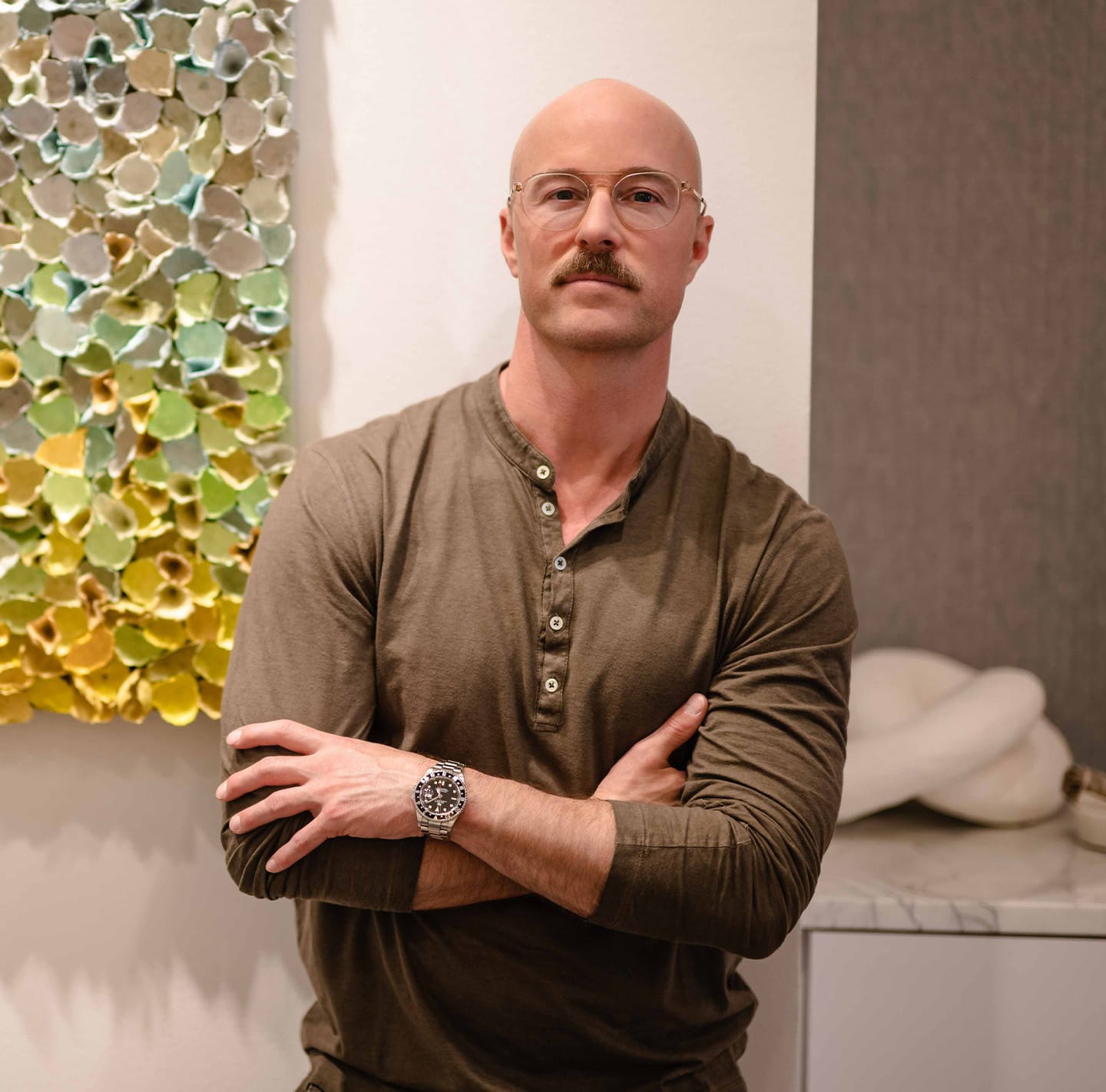
Dr. Rocco Piazza II
Board-Certified Plastic Surgeon
Dr. Piazza is a board-certified plastic surgeon practicing in Austin, TX. He specializes in aesthetic and reconstructive surgery with a focus on natural results.