


Nurse practitioner & laser provider · The Piazza Center, Austin, Texas
In aesthetics since 2006 · Updated September 2026
The Case at a Glance
Patient: Woman, Age 54
Concern: Sun-related pigmentation and early fine lines
Treatments: BBL HERO + MOXI, with Botox Cosmetic
Provider: April Daniel, APRN, FNP-C
Areas Treated: Full face
Downtime: Minimal — social by the end of the week
Pigment Note: BBL HERO and MOXI do different jobs. BBL targets the pigment itself; MOXI resurfaces the skin around it. Run together, they clear the spot and improve the canvas it sat on — which is why combination treatment reads more natural than either alone.
Most laser before-and-afters online are photographed to flatter. Different lighting, a fresh blow-dry, a smile in the second frame. So it is worth saying plainly what you are about to look at: same camera, same position, same head-immobiliser, eyes closed in both. What changed is the skin.
This is a 54-year-old patient treated by April Daniel, APRN, FNP-C with a combination of BBL HERO, MOXI and Botox Cosmetic.
What she came in for
Two things, which is typical at this age and in this climate. Sun-related pigmentation — discrete brown spots on the cheeks with diffuse mottling around them, the accumulated record of Texas summers. And early fine lines in the upper face, the horizontal forehead lines that show at rest once the skin has lost some of its bounce.
Those are two different problems with two different solutions, and treating one without the other is why some patients feel their result is incomplete. Pigment is a laser problem. Dynamic lines are a neuromodulator problem. She had both addressed.
The result, front view
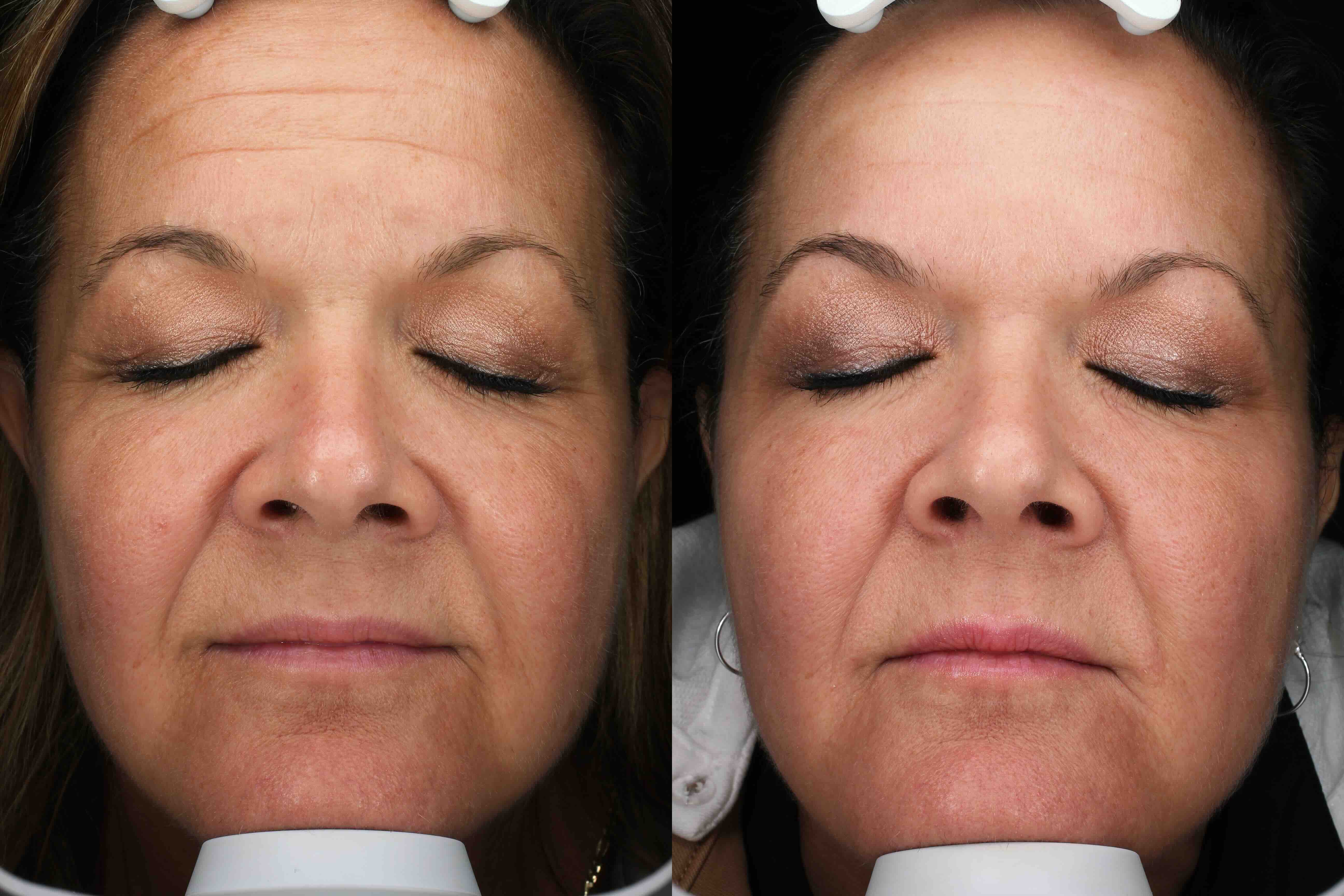
Before, left. After, right. Same lighting and position. Individual results vary.
The forehead lines that were etched across the top of the frame have softened, and the overall tone has evened out. Note that she still has expression — the brow is not frozen and the face still moves. That is deliberate, and it is the difference between a treated face and an obviously treated face.
Where the laser did its clearest work
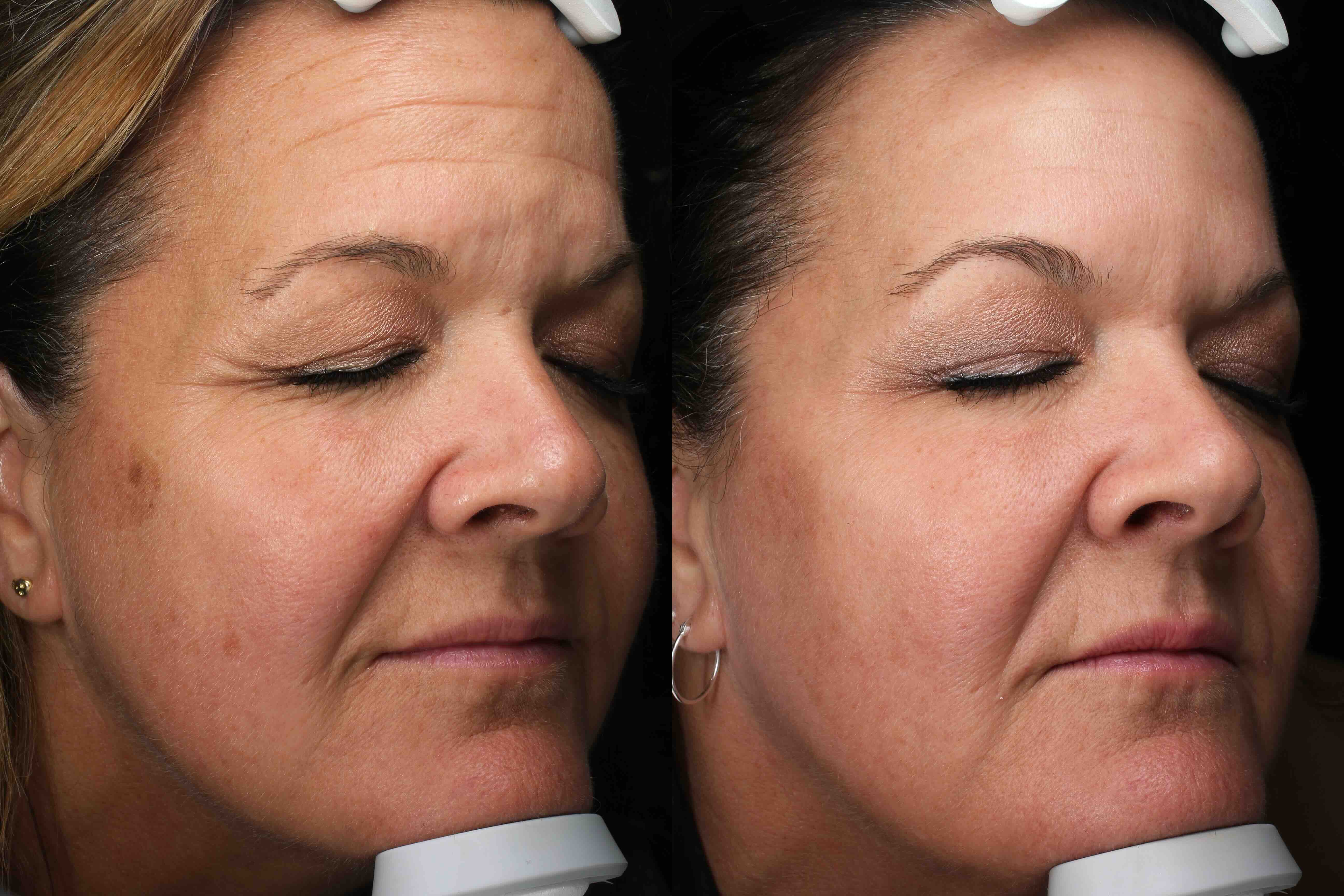
Left three-quarter view. The discrete lentigo on the cheek and the mottling around it. Individual results vary.
This is the frame that shows what BBL actually does. In the before, there is a defined brown lesion on the left cheek with a scatter of smaller pigment around it. In the after, that lesion has substantially cleared and the surrounding skin reads as one tone rather than several.
BBL HERO is broadband light — it targets pigment and vascular concerns by delivering energy that the darker material absorbs preferentially. Spots typically darken first, come to the surface over several days, and flake away. It is not instant, and any provider promising instant is overselling it.
And the other side
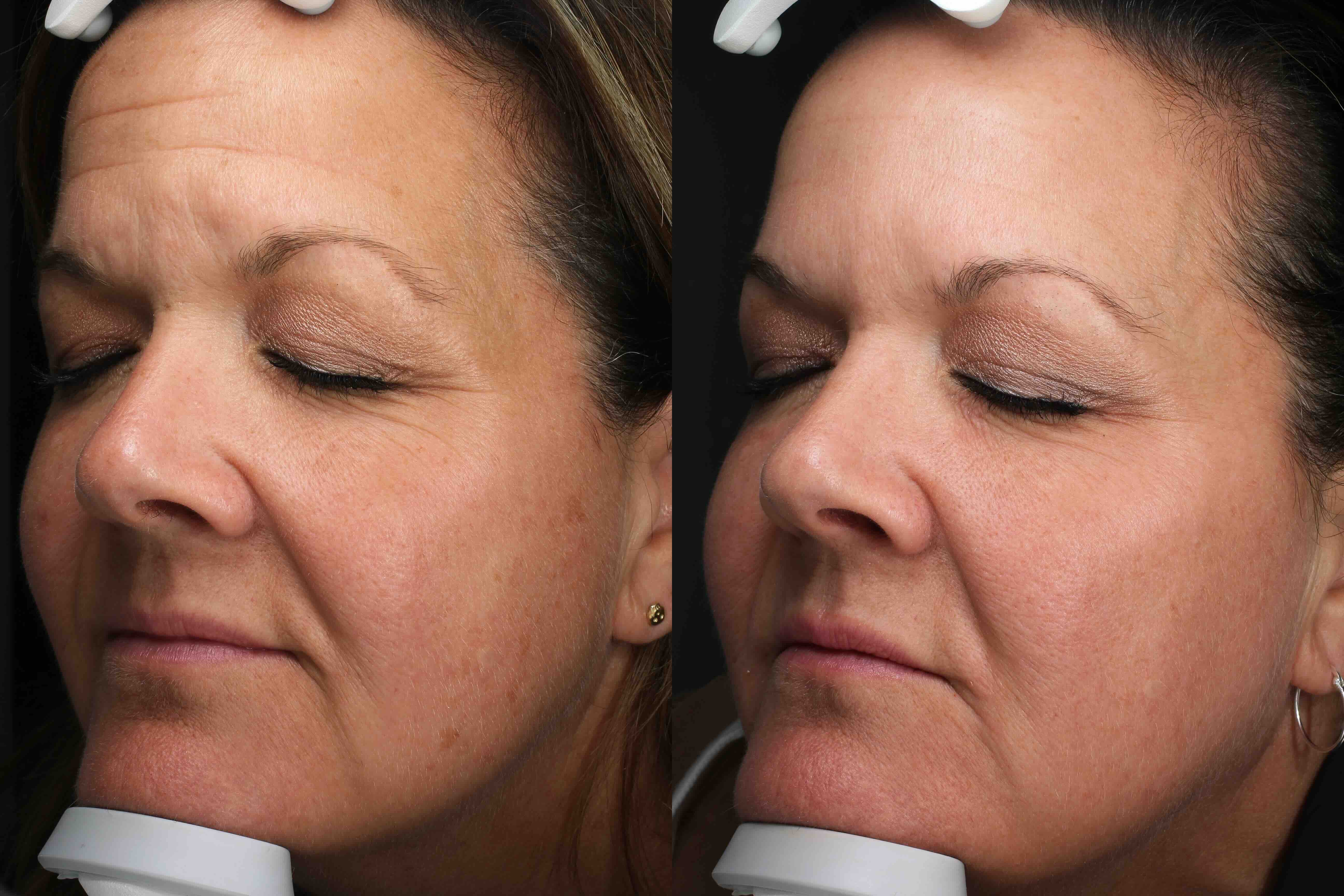
Right three-quarter view. Reduced freckling and smoother overall texture. Individual results vary.
The right side shows the MOXI contribution more than the BBL. MOXI is a non-ablative fractional laser — it works on texture, tone and the general quality of the surface rather than on individual spots. The skin here simply looks smoother and more uniform, which is harder to point at than a cleared spot but is what makes the whole face read younger.
Why April runs them together
“As a nurse practitioner, my goal is to provide competent, compassionate, and holistic care using evidence-based practices. I believe that by empowering patients with knowledge, we can begin to establish trust and long-term relationships.”
— April Daniel, APRN, FNP-C
April has been in aesthetics since 2006. She trained at Texas Tech and worked in ICU and oncology before moving into aesthetic medicine — which matters more than it might sound, because a provider who has managed critically ill patients has a different relationship with caution than someone who has only ever worked on healthy skin.
Her areas of focus are BOTOX Cosmetic, Dysport, dermal fillers and BBL. That combination is exactly why a case like this one works: the same provider is assessing the pigment and the dynamic lines in one sitting, rather than two people solving half a face each.
Dr. Rocco C. Piazza, MD, FACS sets the medical guidance and protocols for our non-surgical services. The treatments themselves are performed by our non-surgical team of nurse injectors and medical aestheticians — in this case, April.
What we send patients home with now
A note on timing. This patient was treated before we changed our post-procedure protocol, so what follows is not what produced the result above. It is what we would send her home with today, and why we made the change. We would rather draw that line clearly than let a product take credit for a result it had nothing to do with.
The laser is the appointment. The weeks afterward are what protect the result — and on a pigmentation case specifically, aftercare is not a nice-to-have. It is the difference between clearing pigment and trading one kind for another.
Here is the risk nobody mentions when they sell you a laser. Any device that creates controlled injury also creates inflammation, and inflammation in skin that is already prone to pigment can produce post-inflammatory hyperpigmentation — new discoloration where the treatment was. It is the single most common way a good pigment result gets undone, and it is largely preventable.
That risk is why our post-procedure protocol changed this year.
Day 0 — Pavise Extracellular Matrix Restore
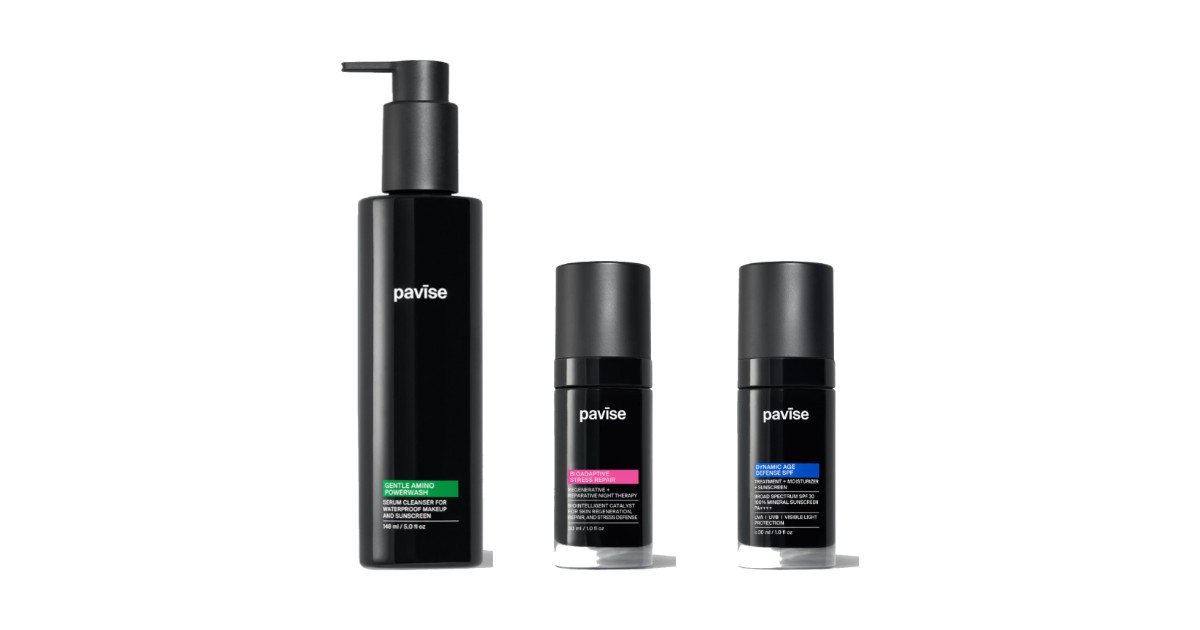
ECM Restore goes on immediately, on its own, with nothing layered over it. It is a post-treatment matrix activator: rather than simply sealing the skin, it is formulated to direct how the new matrix rebuilds during the window when fibroblast activity is highest. Pavise also lists helping to prevent post-inflammatory discoloration among its benefits, which is precisely the concern on a pigment patient.
It is the subject of a registered clinical trial (ClinicalTrials.gov NCT07462533) evaluating it as the primary occlusive treatment immediately following ablative resurfacing. A registered trial is not a finding of efficacy and we will not present it as one — but it tells you where the manufacturer is willing to be measured.
Pavise Extracellular Matrix Restore
Post-procedure matrix activator, 30 ml · starts day 0 · $278.00
Shop Pavise Extracellular Matrix Restore →
Day 2 — carboxy therapy
Dr. Medion Spaoxy Gel comes in on day two to cool and calm the treated skin. Not before — the first 48 hours belong to ECM Restore alone.
Day 3 onward — mineral SPF, permanently
On a pigmentation case this is the whole ballgame. Pigment is caused by sun. Clearing it with a laser and then not protecting the result is paying for the same treatment twice. A daily mineral SPF is not the optional extra on a pigment protocol — it is the protocol.
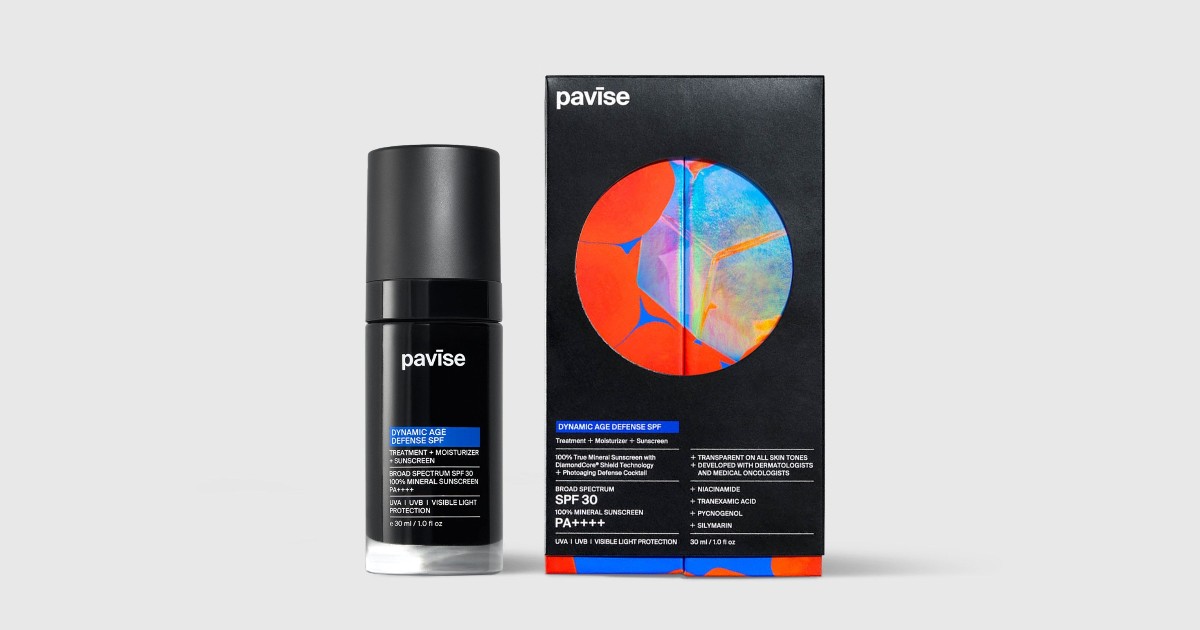
Pavise Dynamic Age Defense SPF 30
100% mineral, PA++++, visible light protection, 30 ml · $148.00
Shop Pavise Dynamic Age Defense SPF 30 →
Visible light matters here and most sunscreens ignore it. Visible light — not just UV — is a documented driver of pigment in deeper skin tones, and a standard SPF number says nothing about it. That is a real consideration when the reason you had the laser was pigment in the first place.
The full sequence, and why we moved off what we used before, is in our laser recovery guide and the Alastin alternatives comparison.
the full Laser Recovery Protocol
Everything we send patients home with after a laser, in the order we use it
Shop the full Laser Recovery Protocol →
Frequently asked questions
How many BBL sessions will I need?
It depends on how much pigment there is and how deep it sits. Many patients see meaningful clearing from a single session, and a series produces more. April will give you a realistic number at your consultation rather than a package quote before she has looked at your skin.
What is the difference between BBL and MOXI?
BBL HERO is broadband light and targets pigment and vascular concerns — individual spots and redness. MOXI is a non-ablative fractional laser and works on overall texture and tone. They address different problems, which is why they are often run together.
Does BBL hurt?
Most patients describe it as a quick snap of heat, warm rather than sharp. It is well tolerated and does not usually require numbing, though we can discuss comfort options.
What is the downtime?
Minimal. Expect redness and warmth for a day, then treated pigment darkens before flaking away over roughly a week. Most patients are comfortable socially within a few days.
Can I have Botox at the same appointment as a laser?
Often yes, and sequencing matters. April will decide the order and timing based on your treatment plan at the visit.
Who performs the laser treatments?
Our non-surgical team. Dr. Piazza sets the medical protocols; April Daniel, APRN, FNP-C, performs the laser and injectable treatments.
Will the pigmentation come back?
Sun exposure is what caused it, so without daily protection new pigment will form over time. Daily mineral sunscreen is what preserves the result.
Individual results vary. Photographs are of an actual patient of The Piazza Center, published with consent, and are unretouched composites shot in matched lighting and position. The post-procedure products described are our current recommendations and were not used by the patient shown. This article is for educational purposes and does not constitute medical advice. Suitability for any treatment is determined at consultation.
Ready to treat your pigmentation?
Book with April Daniel, APRN, FNP-C and she will tell you which laser fits your skin and how many sessions it will realistically take.
Book a ConsultationSee More Results
April Daniel, FNP-C
Board-Certified Plastic Surgeon
Dr. Piazza is a board-certified plastic surgeon practicing in Austin, TX. He specializes in aesthetic and reconstructive surgery with a focus on natural results.